
For CHILD-BRIGHT’s Parent Mentor, Support & Advocacy Runs in the Family

At CHILD-BRIGHT, our work revolves around research, but today, we say 'thanks' to our many patient-partners who are engaging in distinct work outside our network also, to help youth with brain-based disabilities in their communities. Meet Carrie & Emma:
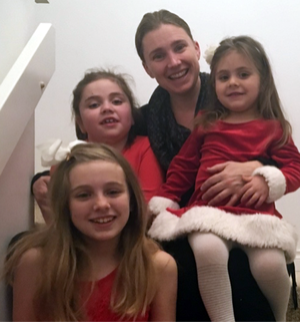
Carrie Costello with her three daughters.

Carrie Costello with her three daughters.

In 2019, Carrie Costello, one of our BRIGHT Coaching parent-partners and a mother of three daughters, stepped into the role of CHILD-BRIGHT’s Parent Mentor. Since then, she has connected and collaborated with parents from all over Canada to learn more about their life and experience with disability in their home provinces and about their needs and experiences as research partners. 

Carrie and her family recently made headlines for reasons other than her role as a Parent Mentor, however. Carrie’s middle daughter, Alejandra, has a profound intellectual disability and a seizure disorder with Todd’s paresis. She receives occupational therapy, physiotherapy, and speech pathology support at her school in Winnipeg. When the Winnipeg School Division published its proposed budget for 2021-2022 earlier this year, it indicated its intention to cut these services, arguing the services should be funded by Manitoba Health. However, the School District had not spoken to Manitoba Health about this proposition. This change would also profoundly impact the team approach to supporting children with additional needs. 

When this news hit, the family did not stay still for long. Elder daughter Emma, in particular, leapt into action, mobilizing to start a petition to stop the cut to services.

The petition, and Emma and her family’s advocacy, quickly gained traction, garnering over 4,400 signatures. Emma, along with parents Carrie and Pablo, was interviewed on CityNews, speaking eloquently to the impact that such cuts would have for her sister.

A couple of weeks later, the good news arrived: the 2012-2022 Winnipeg School Division budget would not cut physiotherapy and occupational therapy for students with disabilities.

“I am so happy that it worked!” Emma shared with us. “Not only was it the petition that helped, but it was also the work of many people who stood up against this. I hope that this will help those in power realize the impact of removing occupational and physio therapists.”

Carrie expressed immense pride at seeing her eldest daughter taking a stand: “Watching Emma advocating for her sister means so much to me. When she is passionate about an issue, she throws herself in and makes a difference. It gives me great hope for the future.”
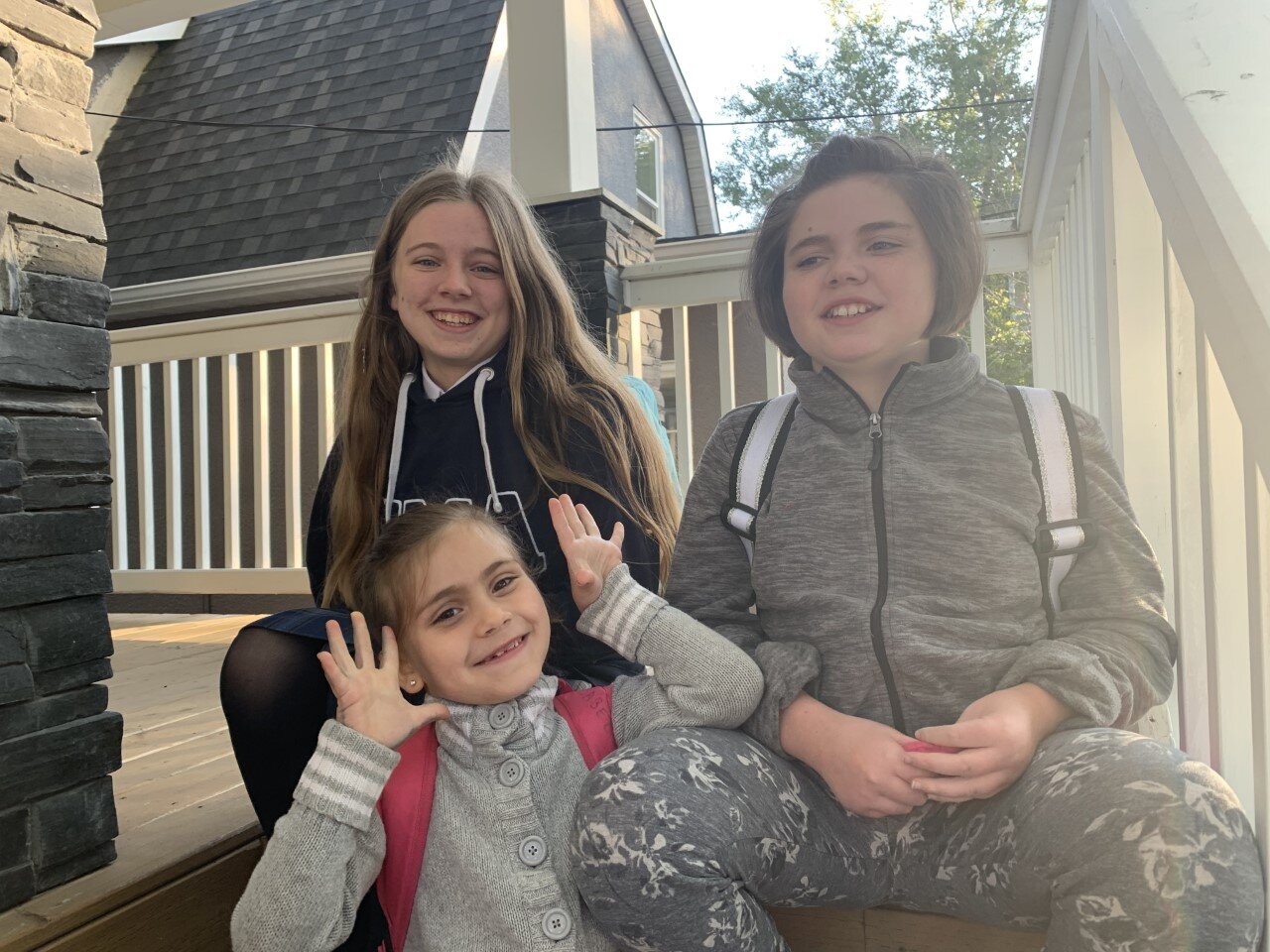
Emma Felices-Costello with sisters Alejandra (right) and Isabel (bottom left)

Emma Felices-Costello with sisters Alejandra (right) and Isabel (bottom left)

This does not mark the first time Emma has spoken up as a sibling. In October 2020, she was one of three youth who addressed the United Nations Committee on the Rights of the Child (CRC) during the children’s meeting for Canada, as part of the 87th pre-session of the United Nations (UN) Committee on the Rights of the Child. At the meeting, Emma spoke up on behalf of ‘glass’ children—siblings of a child with special needs, who are often overlooked by the higher needs of their sibling, and who must also often help to support them later in life. Read her full testimony to the committee here.

We’re heartened to see such strong and heartfelt youth advocacy in action! It’s proof that making your voice heard in support of a cause that matters to you can yield great results.
2019-20 Report to Community Now Available

Français

The CHILD-BRIGHT Network Report to Community for the fiscal year ending March 31, 2020 is now available.

Download the PDF

A special thank you to our funding partners for their ongoing contributions and commitment, and to all the patients, families, committee members, and CHILD-BRIGHT supporters who guide us in our work.

Our Report to Community is also available in French

SPORT project wins 2021 ConneKT Funding

Français

We are proud to announce that the Stimulation for Perinatal Stroke Optimizing Recovery Trajectory (SPORT) Project has been awarded a 2021 CHILD-BRIGHT ConneKT Fund grant, which provides funding of up to $5,000 to CHILD-BRIGHT research teams to help them finance knowledge translation events or products that increase engagement with community partners, achieve meaningful stakeholder participation, and build positive relationships between stakeholders and project members. 

Leads

Funding amount granted:
$4,944.06

Project summary:
Children with disabilities may feel particularly isolated in the winter, especially given current COVID-19 restrictions. The MEGA-Mess Activity e-book is intended to get children with disabilities moving. The e-book will feature biographies of children with hemiplegic cerebral palsy who participated in the SPORT trial as well as their favourite recipe, scientific experiment, and craft. Via MEGA-Mess, activities adapted for children with physical disabilities will get them using their hands and encourage families to connect with others, sharing their inspiring stories and perspectives from SPORT. Given that the ebook will be available online, dissemination potential is extensive.

CONGRATULATIONS!

Are you a CHILD-BRIGHT research project with a knowledge translation idea to increase engagement with community partners? Applications for our ConneKT fund are ongoing! For more information and to apply, contact kt@child-bright.ca.

CHILD-BRIGHT Conversations: Getting To Know Our Patient-Partners  |  Meet Dana Geall

Français

As a patient-oriented research network, CHILD-BRIGHT’s success hinges on active partnerships and meaningful collaborations between our members, from patients and their families to researchers, health professionals, and decision-makers in health care. Across the network, around 70 patient-partners regularly collaborate on research projects, sit on committees, and actively contribute to the research on childhood brain-based developmental disabilities happening across Canada.

This series is a result of conversations that took place in 2020 with five of our patient-partners. By sharing their experiences and motivations, we hope to stimulate ever-growing connections across our projects, programs, and committees, and better understand the variety of experiences that these individuals bring to bear on their partnerships with us. Next up is our conversation with Dana Geall.

Dana Geall PP Conversation.jpg

Dana Geall is a woman who wears many hats. “First and foremost, I am a mom,” she says proudly. She is a parent to triplets Brody, Taylor and Cole, who all have cerebral palsy (CP), and Jagger, now 2.5 years old.

 Before the birth of the triplets, she was a teacher. After their birth, Dana switched gears and in 2010 founded Three to Be, a registered charity in support of children with neurological disorders and their families. Over the next seven years, with Dana at the helm as executive director for several of those years, Three to Be would raise over $5 million to support research into neurological disorders.

One of the research projects funded by the charity would eventually, in 2016, become CHILD-BRIGHT’s Enhancing Brain Repair with Metformin (Metformin in CP) project. At that time, Three to Be also joined CHILD-BRIGHT as a gold-level funding partner. The Metformin in CP project team is evaluating whether a drug called metformin, combined with physiotherapy, enhances motor and thinking skills in children with CP.

She joined the project as a parent-partner and now contributes her expertise as a member of the project’s Stakeholder Engagement Committee (SEC), consisting of five stakeholders with a wide range of lived experience in the CP community.

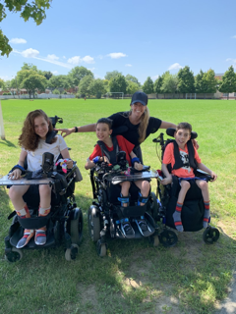
Dana with Brody, Cole, and Taylor (from left to right) on a grassy field.

Dana with Brody, Cole, and Taylor (from left to right) on a grassy field.

This all means that Dana has been able to observe the progression of the study from its very beginnings to today:  “It's been a beautiful kind of relationship, watching it go from an idea to a pilot trial to an actual clinical trial that's hopefully going to help kids,” she shares. (The project has since begun enrolling participants for its clinical trial.)

While that’s been an exciting experience, wearing these different hats has not come without its own set of personal challenges: while all three of the triplets were screened for eligibility for the study, none was ultimately deemed eligible. “As a parent who has been a part of the process since the laboratory research phase, this was extremely devastating.”

“You have your parent hat that prioritizes your own kids and wants to make sure that they are going to be a part of this trial,” she explains. “At the same time, because I am a part of the stakeholder engagement committee and because I have always cared about all kids who could benefit from such treatments, you want to make sure that [the trial] is safe for these kids and that they meet the criteria [for the study].”

Despite that bittersweet note, Dana has gleaned much insight into the research process over the years, from her time as executive director of Three to Be, then as a patient-partner. She’s realized just how much is involved in conducting such a research study, she says, and how long it can take to see results that can help affected populations: “For the families, the most difficult part of it all is waiting and waiting and waiting, because all you want to do is help your kids, as well as other kids like your kids.”

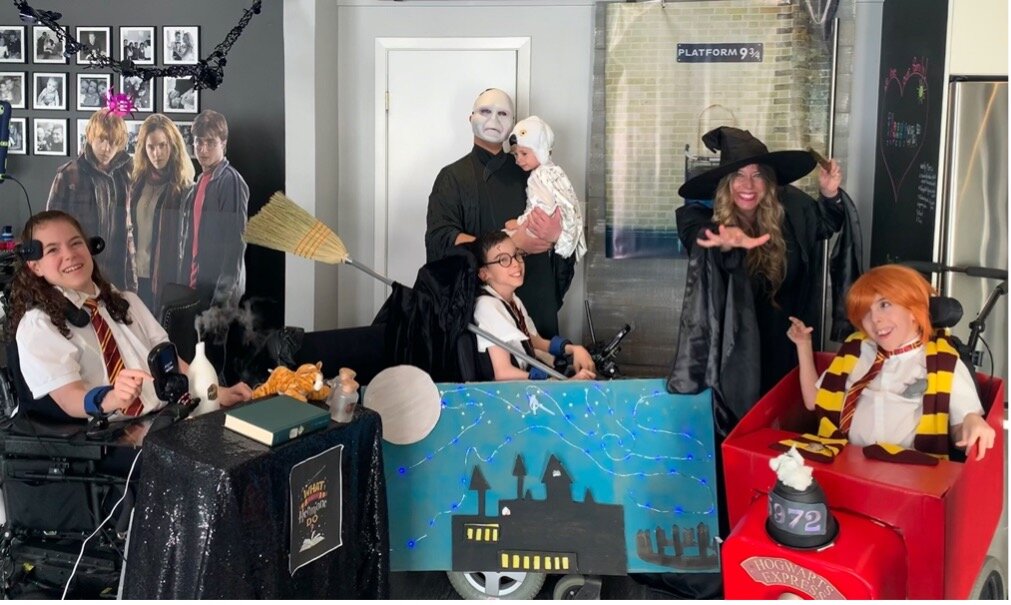
Pictured: (From left to right) Taylor, Cole, and Brody, with Dana’s husband Jason holding Jagger and Dana standing behind them, celebrate a very Harry Potter Halloween.

Pictured: (From left to right) Taylor, Cole, and Brody, with Dana’s husband Jason holding Jagger and Dana standing behind them, celebrate a very Harry Potter Halloween.

She is also convinced of the importance of patient-partnership in research. “I think it's so important for the parents and the patient's voice to be heard by the people who are running the study. I think it's a beautiful partnership,” she shared.

“The beautiful thing about CHILD-BRIGHT is that they actually really prioritize this partnership, and they thought it was really, really important to make sure that the people they hope to help are being heard.”

Being a part of the network has also meant tapping into a strong community of parents who have taught her about research and about parenting: “Everyone brings their own unique expertise to it all, and I always learn from other parents!”

“We are kind of like our own little village that supports one another and gets it,” she continues. “There really is a huge community of people that are facing similar challenges and if you lean on one another, it makes the process and the journey so much better and so much easier.”

Thank you to Dana Geall for taking the time to share her perspective with us!

To read the first profile in this series, with Strongest Families ND partner Sharon McCarry, click here

Gillian Backlin: How I got involved in patient-oriented research and why

Français

Are you wondering why it might be worthwhile for you or your child to take part in a patient-oriented research study? In our “What’s My Why” blog series, hear from five CHILD-BRIGHT patient-partners on the many reasons they decided to get involved in research.

In this post, Gillian Backlin, National Youth Advisory Panel member, shares her “why”.

Gillian Backlin circle.png

I’m new to patient-oriented research. In fact, I just got involved through CHILD-BRIGHT’s National Youth Advisory Panel. What drew me to CHILD-BRIGHT was the opportunity to do something positive for a community that I feel so strongly connected to through my own experience as someone with a brain-based disability. Advocating has always been a passion of mine and I felt that this was an incredible chance to not only be heard but to make a positive impact. CHILD-BRIGHT really helped me see the value in my perspective and gain more confidence as an advocate, not only for others, but for myself. I think having access to firsthand experiences is valuable for both the patient and the researcher, because it adds a much-needed personal element to research and empowers the patient to value their thoughts, opinions and experiences. I’m so grateful for the opportunity to be a part of patient-oriented research at CHILD-BRIGHT. 

Interested in enrolling in a CHILD-BRIGHT research project? View our study recruitment opportunities here