
Welcome to Sierra Lynne, NYAC Co-Chair!

French
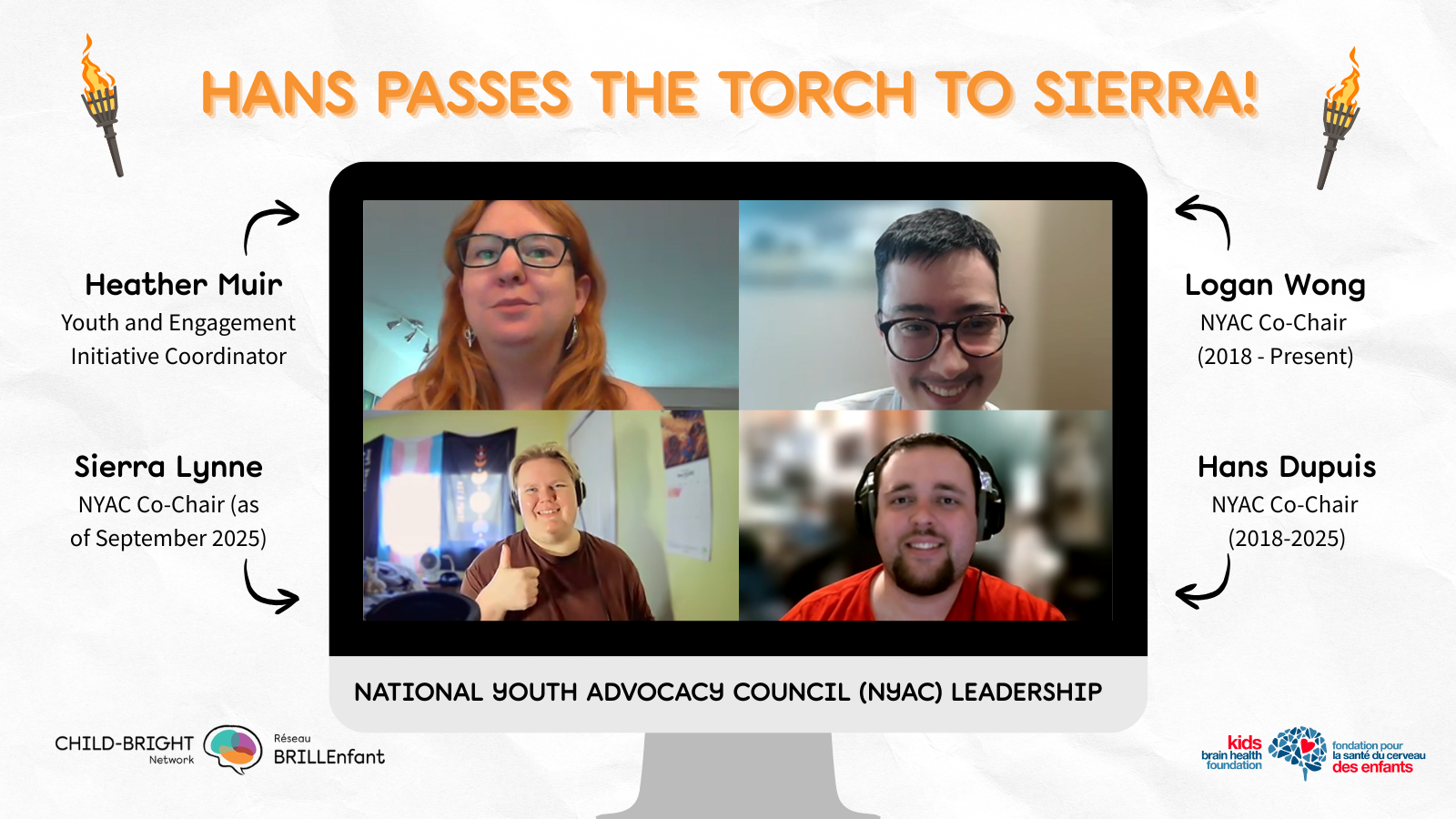
Hans passes the torch to Sierra! Four members in a video call, highlighting the leadership handoff from Hans Dupuis to Sierra Lynne.

After seven years of co-leading the National Youth Advocacy Council (NYAC), Hans Dupuis is stepping down from his role and passing the torch to a new voice in youth leadership. 

We’re excited to welcome Sierra Lynne as the new NYAC Co-Chair, starting in September 2025! 

Sierra joined the NYAC in 2022 through our partnership with Kids Brain Health Network (KBHN) and has been a passionate and committed member ever since. Known for his willingness to try new things, ask thoughtful questions, and grow his skills, Sierra has contributed to a wide range of communications and network projects with both KBHN and CHILD-BRIGHT. 

In particular, he’s played a leading role in the NYAC media series, showcasing his creativity in collaborative youth engagement. 

“Sierra has made impactful contributions to our council using his expertise in social media and communications to represent the NYAC in meetings, on paper, and on-screen. The leadership he has shown with the media series gives me confidence that, as a team, we can continue to keep our goal of advancing the field of patient-oriented research and youth engagement alive for years to come.” 
— Heather Muir, Youth and Engagement Initiative Coordinator

We’re grateful to Hans for his years of steady leadership, and look forward to seeing Sierra and returning Co-Chair Logan Wong work together to shape the next chapter of the NYAC. 

As the first transgender co-chair team, Sierra and Logan bring lived experience, insight, and resilience that enrich the NYAC’s vision of equity, inclusion, and authentic youth engagement. 

“While I discovered my diagnoses of autism and attention deficit disorder separately from my trans identity, it’s those blocks that build up who I am. It defines how I approach every issue we discuss within NYAC. I view the world in a very specific lens, and I use that perspective to demonstrate what we need as disabled youth. I’m honoured to be voted as a co-chair by my fellow youth advocates!” 
— Sierra Lynne, Co-Chair of the National Youth Advocacy Council
Learn more about the NYAC

CHILD-BRIGHT welcomes three new patient-oriented research leaders

FRANÇAIS

This summer CHILD-BRIGHT welcomed three patient-oriented leaders to the network. 

Marie-Brossard Racine and Stephanie Glegg are CHILD-BRIGHT’s newest Scientific Co-Directors.  

We are also thrilled to welcome Audrey Wubbenhorst to our network as Training & Capacity Building Program Co-Lead, following the retirement of inaugural program lead Dan Goldowitz. 

Marie, Stephanie, and Audrey are already helping guide CHILD-BRIGHT as we collectively seek to ensure the sustainability and legacy of our patient-oriented research work, for children, youth and families. Learn more about them below: 

Meet our new Scientific Co-Directors:

CHILD-BRIGHT’s Scientific Co-Directors are responsible for the strategic and operational leadership of the network. Marie and Stephanie will join incumbent Co-Directors Annette Majnemer, Nominated Principal Investigator of the Network, and Steven Miller, Implementation Science Research Program Co-Lead, in advancing research initiatives and fostering collaboration, to ensure the network's objectives are met and its impact is amplified. 

While the co-directorship may represent a new chapter for Marie and Stephanie, they are far from new to CHILD-BRIGHT.   

Marie Brossard-Racine

Marie Brossard-Racine smiling at the camera against a light purple backdrop. She is wearing a dark green shirt with pink and green flowers.

Marie Brossard-Racine, OT, PhD has been a friend of the network since its inception, serving on the Training Committee in Phase 1.  What she learned about patient-oriented research through CHILD-BRIGHT has had a transformative impact on her research program:

Informed by my time on the Training Committee, and my enduring commitment to mentorship, I have a strong desire to nurture the next generation of patient-oriented researchers.
— Marie Brossard-Racine

She is a pediatric neuroscientist and developmental specialist at the Research Institute of McGill University Health Centre, where she also co-leads the Child Health and Research Program. A tenured Associate Professor at McGill University’s School of Physical and Occupational Therapy and Associate Member of the Departments of Pediatrics and of Neurology and Neurosurgery, Marie currently holds a tier-2 Canada Research Chair in Brain and Child Development.  

 Marie worked for many years as a pediatric Occupational Therapist in Quebec. Marie worked for many years as a pediatric Occupational Therapist in Quebec and trained in rehabilitation sciences and neuroscience.  She returned to McGill in 2015 to launch the Advance in Brain and Child Development Research Laboratory where she used her multidisciplinary expertise to build new knowledge to better understand the underlying mechanisms of neurodevelopmental disorders and determinants of outcome trajectories in individuals with brain-based disorders.  

Since 2024, Marie has also acted as CHILD-BRIGHT francophone champion for the network, ensuring our patient-oriented research is amplified in Quebec and French-speaking audiences across Canada.

By taking on the Scientific Co-Director role, I hope to increase awareness of the network’s activities to new groups of users as well as develop new collaborative opportunities so that patient-orient research is because accessible and a standard for child health research.
— Marie Brossard-Racine

Stephanie Glegg

Stephanie Glegg smiling at the camera against a grey, purple and light blue backdrop, she is wearing a navy blue cowl neck shirt.

Similarly, Stephanie Glegg, OT, PhD’s time with CHILD-BRIGHT began in 2016 as a Knowledge Translation (now Knowledge Mobilization) Committee member, and co-investigator on the Jooay research project. Since 2022, she has co-led the Knowledge Mobilization (KM) Program to help move knowledge into action in child health at the national level, served on the network’s Executive Committee and Network Steering Committee, and has co-led two CHILD-BRIGHT-funded implementation studies (Pain Pathway [PIUO] & Parent Voices).

An Assistant Professor and implementation scientist in the Department of Occupational Science and Occupational Therapy at the University of British Columbia with Associate Membership in the Department of Pediatrics, and as an Investigator at BC Children’s Hospital Research Institute, Stephanie studies the most effective ways to move knowledge into action (i.e., knowledge mobilization) to improve health care services, health systems and health outcomes for children with exceptionalities/disabilities and their families.

Stephanie’s research aims to make practical changes that enhance the experiences of children/youth, families and health care providers, and to support informed health care decision-making based on research, lived experience, clinical experience, and other ways of knowing and being. She partners with children/youth, families, community organizations, health professionals, decision-makers and others, whose involvement throughout the research process drives meaningful change from diverse perspectives.

Stephanie also has expertise in neurodevelopmental conditions as a registered pediatric occupational therapist. She worked for 18 years at Sunny Hill Health Centre at BC Children’s Hospital with children with a range of diagnoses. In her role as knowledge broker with the Child Development & Rehabilitation Evidence Centre at Sunny Hill during this time, she supported the use of evidence to inform decision-making by health care providers, leaders, students and families.

Stephanie comes from Irish, Scottish, and English settler ancestry. She is a mother of two from a neurodiverse home, and an avid baker.

For me, being a leader in patient-oriented childhood research disability research is about lifting others up and ensuring that their voices are also heard, included, and that they have the power to make meaningful change. This is key for CHILD-BRIGHT’s mission of contributing to helping transform pediatric health care in Canada.
— Stephanie Glegg

MEET OUR TRAINING & CAPACITY BUILDING PROGRAM CO-LEAD

We’re also pleased to welcome Audrey Wubbenhorst to the network, as she joins Celia Laur as Training & Capacity Building Program Co-Lead.

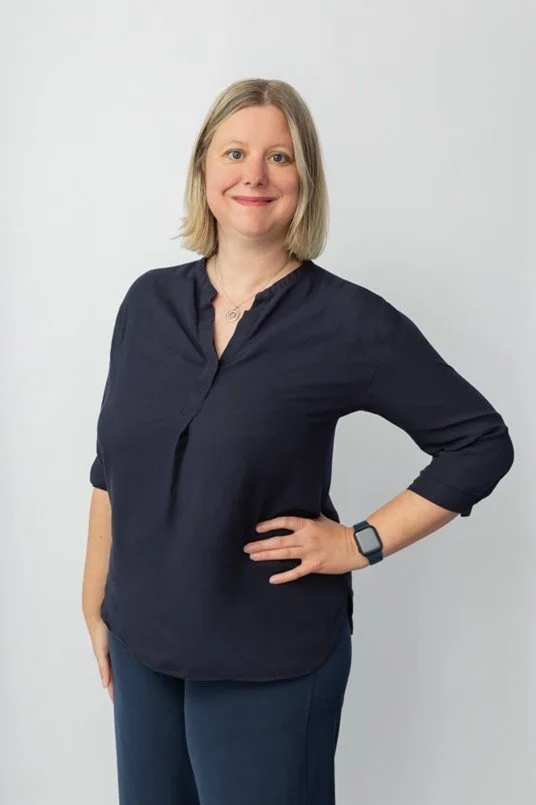
Aubrey Wubbenhorst photographed smiling at the camera against a grey backdrop. She is wearing a navy blue shirt and pants, her left hand is on her hip.

The program is responsible for establishing the training and mentoring agenda of the network. Engaging with multiple groups, including partners with lived and living experience researchers, and policymakers, the program is fostering a culture of patient-oriented research that will not only positively affect the future of health research within Canada, but also lead to improved outcomes for children with brain-based developmental disabilities and their families.

Audrey is a professor, school trustee and board director. She has an MA in Communications and an MBA and graduated with a BA (Hons) from McGill University. In 2024, she completed a micro-credential from McMaster University in Family Engagement in Research.

Audrey now teaches communications and business strategy at Humber College. She is also a member of the Research Ethics Board at Holland Bloorview Hospital.  Before joining Humber, Wubbenhorst spent over 12 years at BMO Bank of Montreal.  She has worked in various roles, including diversity and workplace equity, communications, marketing, and human resources. She has served on several boards, including the CAAT pension plan, FirstOntario Credit Union, CNIB Lake Joe, Central LHIN, Build Toronto, Toronto Community Housing Corporation and Ernestine’s Women’s Shelter.  She has also served on the board of Scouts Canada, the National Diabetes Trust Corporation (known as the Clothesline program), and the Institute of Corporate Directors (ICD) West chapter.

I’m thrilled to be the first partner with lived and living experience to take on this role. I am committed to ensuring that CHILD-BRIGHT’s training and capacity building work includes the experiences of families.
— Audrey Wubbenhorst
Subscribe to stay connected

Goldowitz Emerging Trainee Leader Award: Apply by November 17, 2025

FRANÇAIS

The CHILD-BRIGHT Network is proud to announce the creation of the Goldowitz Emerging Trainee Leader Award, granted in recognition of exceptional trainee leadership in pediatric brain-based developmental disability research. Established in 2025, the award was named in honour of Dan Goldowitz for his vital contributions to the network’s impressive growth as an entity under Canada’s Strategy for Patient-Oriented Research.  

This award recognizes a CHILD-BRIGHT trainee at the doctoral or postdoctoral level who has demonstrated exceptional leadership, including spearheading new initiatives and mentoring others.

Eligibility 

Applicants must fall into one of two categories: 

  1. A doctoral student who is or has been involved in CHILD-BRIGHT 

  2. A postdoctoral fellow who is or has been involved in CHILD-BRIGHT 

Applicants should have considerable experience participating in patient-oriented research activities and a proven track record of leadership in research. Applicants may self-nominate or be nominated by another researcher or individual. 

Submission 

The application package must include: 

  • A letter of intent, maximum 2 pages in length, describing the rationale for nomination, relevant POR and/or training leadership experience, and relevant leadership experience in pediatric brain-based disability research 

  • Curriculum vitae highlighting leadership activities (optional) 

  • 2 letters of support 

  • Any other relevant information you would like us to consider 

Application procedure 

Submit your application package by November 17, 2025. Awardees will receive a personalized plaque and be featured on CHILD-BRIGHT’s website, as well as a registration and travel allowance of up to $800 for a conference of their choice (in Canada or the United States). Travel needs to be booked by December 2026 to be eligible for the allowance. 

APPLY BY November 17, 2025

Dan Goldowitz steps down: Recognizing 10 years of inspired POR capacity-building leadership

FRANÇAIS

After nearly a decade of devoted work and inspired leadership, Dan Goldowitz has stepped down as founding Scientific Co-Director of CHILD-BRIGHT and academic co-lead of the network’s Training & Capacity Building Program. 

Dan Goldowitz in a striped light blue collared shirt and black blazer and wire frame glasses. Background is blurred.

Dan made his mark on the network from its inception. Alongside Nominated Principal Investigator Annette Majnemer and Implementation Science Research Program Co-Lead Steven Miller, he successfully co-led the effort to launch CHILD-BRIGHT under CIHR’s Strategy for Patient-Oriented Research in 2016. 

The three have expertly helmed the network since that time as Scientific Co-Directors, overseeing its growth to 450 members across two phases of activities.  

In Phase 1 (2016-2021), CHILD-BRIGHT developed novel interventions to improve the health outcomes of children with brain-based developmental disabilities using child and family-focused approaches. To support this mandate, Dan established an ambitious training and mentoring agenda for the network, working in concert with partners with lived and living experience (PWLEs), researchers, and policymakers. His goal? To build the required capacity for patient-oriented approaches to childhood brain-based developmental disability (BDD) research, so that our network could accomplish its goal of creating brighter futures for, and with, children and youth with BDD and their families. 

Fostering the next generation of patient-oriented researchers 

Thanks to Dan’s leadership, the network created a multi-step pathway to teach budding researchers about patient-oriented research. 

As part of the CHILD-BRIGHT Summer Studentship Program, now wrapping up its ninth year, undergraduate students followed a tailored curriculum to learn the key principles of POR. They were also embedded in our research project and program teams and gained hands-on experience as young researchers. To date, nearly 100 summer students have left convinced of the power of POR to improve health outcomes: 

This program has shaped me into a more thoughtful and patient-centered research trainee. I’m excited to continue contributing to health care advancements!
— Natalie, 2024 CHILD-BRIGHT summer student

Trainees further along in their budding research careers could build their capacity to conduct POR through the Graduate Fellowship in Patient-Oriented Research, which offered additional support to graduate trainees undertaking patient-oriented research projects. A total of 16 trainees have developed skills in the real-world application of POR principles.   

Supporting collaboration and innovation  

Dan was also committed to supporting innovative training approaches; two of the program’s special award offerings, the Training Innovation Fund and Collaborative Mentorship Grant funded training initiatives, tools and resources that aimed to develop POR capacity. 

External to the network, Dan was instrumental in co-creating a SPOR National Training Entity, now called Passerelle, and supporting the development of the Patient-Oriented Research Curriculum in Child Health (PORCCH), a series of free, interactive online modules. 

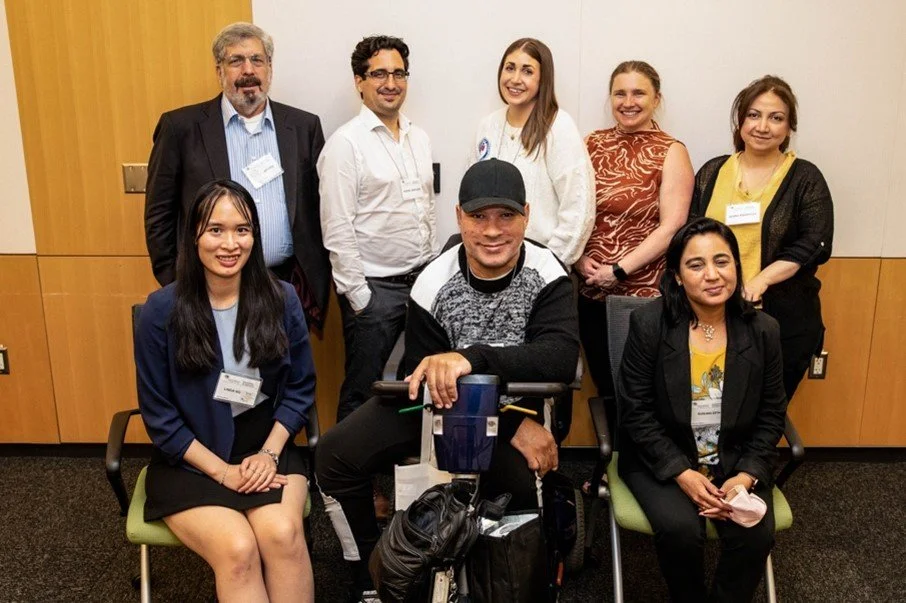
Image of the SPOR National Training Entity team, 5 people standing in the back, and three people seated in front.

Equipping the network for change 

By the time Phase 1 came to a close, the network’s 13 research projects had generated evidence about new therapies, technologies, coaching interventions, and medications that had the potential to help children and youth with BDD and their families. 

Phase 2 has been geared towards this patient-oriented research into action through insight and methods grounded in implementation science (IS) and knowledge mobilization (KM) that embed the principles of equity, diversity, inclusion, decolonization and Indigenization (EDI-DI). 

This transition represented a new need for our Training Program: equipping our members with an evolved set of knowledge and skills in IS, KM, and EDI-DI. To develop capacity in these areas, Dan was joined by implementation scientist Celia Laur to co-lead the Training & Capacity Building Program. 

Together, they ushered in a partnership with Azrieli Foundation to create the Azrieli CHILD-BRIGHT Fellowship Program. To date, the program has supported eight postdoctoral fellows with several others joining soon, to work with a CHILD-BRIGHT research project team. Supported postdoctoral fellows have played a pivotal role in advancing CHILD-BRIGHT’s implementation science research agenda, while learning and applying patient-oriented research approaches to child health, with a focus on knowledge mobilization; implementation science; and equity, diversity, inclusion, decolonization, and Indigenization.  

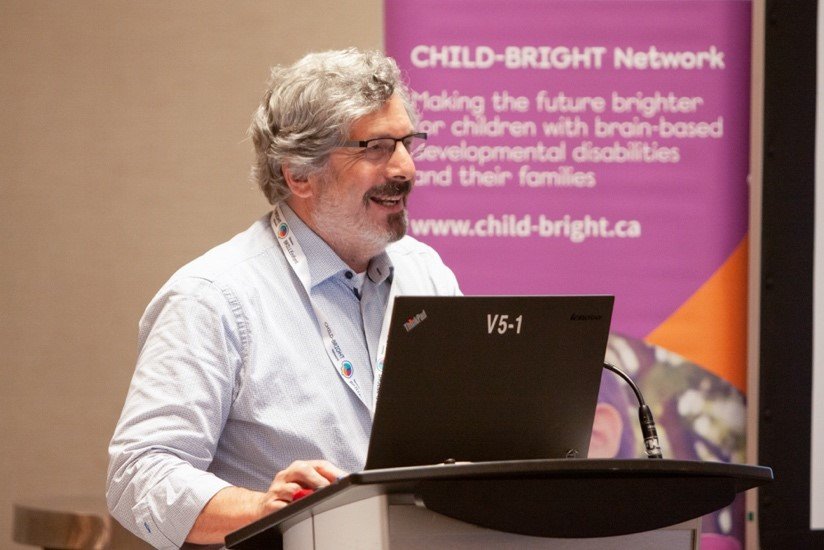
Dan Goldowitz speaking at a podium with a laptop in front of him. The CHILD-BRIGHT pink banner is in the background.
CHILD-BRIGHT could not have become what it is today without Dan! While this chapter is coming to a close, he can pass the baton on to the next generation of patient-oriented researchers he helped train and mentor, safe in the knowledge the future is bright because of his dedication. Thank you to Dan for everything he has done for children and youth with brain-based developmental disabilities and their families.
— Annette Majnemer

 In honour of Dan’s vital contributions to the network, we are proud to announce the creation of the Goldowitz Emerging Leader Award. Learn more and apply.

We are also pleased to welcome two new Scientific Co-Directors, as well as our new Training & Capacity Building Program Co-Lead. Read more.

Subscribe to stay connected

Meet the 2025 Training Innovation Fund (TIF) awardees!

FRANÇAIS

The CHILD-BRIGHT Network is proud to introduce the winners of the 2025 Training Innovation Fund (TIF)! 

Since 2018, this fund has supported innovative, training and capacity-building projects that actively engage partners with lived and living experience (PWLE) in brain-based developmental disability research 

Projects focusing on patient-oriented research (POR), knowledge mobilization (KM), implementation science (IS), and/or equity, diversity, inclusion, decolonization and Indigenization (EDI-DI) were eligible for funding through the 2025 competition. 

Congratulations to the four winning teams!


Accessibility considerations: Enhancing research impact through inclusivity 

PROJECT SUMMARY:  

This project is creating tools and training to make research and KM more accessible and inclusive, especially for people with disabilities. Guided by POR values, the team will review existing best practices, develop a practical toolkit, and offer interactive workshops to help research teams apply inclusive approaches from the start. By involving PWLEs in every phase, this initiative ensures that research is not only accessible but collaborative. Intended result: research that reaches more people, respects diverse needs, and leads to better outcomes for children and families. 

FUNDING AMOUNT GRANTED: 

$10,000 

PROJECT TIMELINE:  

January 2025 – December 2025 


Training modules to build capacity engaging disabled children and multiply marginalized youth in research 

PROJECT SUMMARY:  

This project is creating online training modules to help researchers and trainees meaningfully engage disabled children and increase representation of marginalized youth in research. These young voices are often excluded because of ableism, ageism, racism, or other forms of systemic discrimination – despite being central to the research itself. The training will be co-developed with PWLEs to ensure it reflects real needs and respectful approaches. By addressing this gap, the project will support more inclusive research practices that truly reflect the diverse experiences of children and youth with brain-based disabilities. 

FUNDING AMOUNT GRANTED: 

$10,000 

PROJECT TIMELINE:  

January 2025 – December 2025 


CHILD-BRIGHT Coaching: Developing and piloting a national coach training program 

PROJECT SUMMARY:  

This project team is developing and test a national coach training program for CHILD-BRIGHT Coaching, a virtual support service for caregivers of children with suspected developmental delays who are waiting for diagnoses or services. Long wait times can leave families feeling overwhelmed and alone; this program empowers caregivers and builds resilience during those critical months. The training will be refined and piloted with a Quebec-based organization, helping ensure it works in real-world community settings. By strengthening coach training, this project supports the broader rollout of CHILD-BRIGHT Coaching to better serve families across Canada. 

FUNDING AMOUNT GRANTED: 

$10,000 

PROJECT TIMELINE:  

August 2024 – March 2026 


Empowering caregivers: Co-developing evidence-based sexual health resources to facilitate discussions between caregivers and autistic children and youth 

Headshot of team members. Featuring Disability & Sexuality Lab logo. LEAD: Alan Santinele Martino, Associate Professors, University of Calgary. TRAINEES: Jordan Parks, Trainee, University of Calgary; Thomas Tru, Trainee, University of Calgary.

PROJECT SUMMARY:  

This project will co-create sexual health toolkits to help caregivers have open, informed conversations with autistic children and youth. Developed in partnership with autistic adults and caregivers, the resources will be inclusive, culturally sensitive, and grounded in real experiences. A companion “how-to” guide will share lessons learned about co-creating knowledge with PWLEs. By addressing a major training gap, this initiative will support caregivers and promote equitable access to sexual health education for autistic youth. 

FUNDING AMOUNT GRANTED: 

$9,500.00 

PROJECT TIMELINE:  

January 2025 – January 2026 

These projects showcase what sets the CHILD-BRIGHT Network apart: a commitment to partnering with PWLEs to generate knowledge and transform the healthcare system. Through the TIF, we’re investing in future patient-oriented researchers and brighter futures for children with brain-based developmental disabilities and their families.  

Explore past TIF projects: 

  • Implementation Science and Knowledge Mobilization bite-sized videos for beginners (Part 1, Part 2, Part 3).   

Subscribe to stay connected