
Announcing the recipients of the 2024 Frank Gavin Patient Engagement Awards

FRANÇAIS

We are pleased to announce the recipients of the 2024 Frank Gavin Patient Engagement Leadership Awards, established in honour of CHILD-BRIGHT's first Director of the Engagement Program.  

This year, we are thrilled to recognize two partners with lived and living experience (PWLEs) for their leadership in engagement in research related to brain-based developmental disabilities in children and youth: 

  • Mohammed Merchant  

  • Claire Dawe-McCord  

Learn more about Mohammed and Claire: 

Parent research partner recipient: Mohammed Merchant 

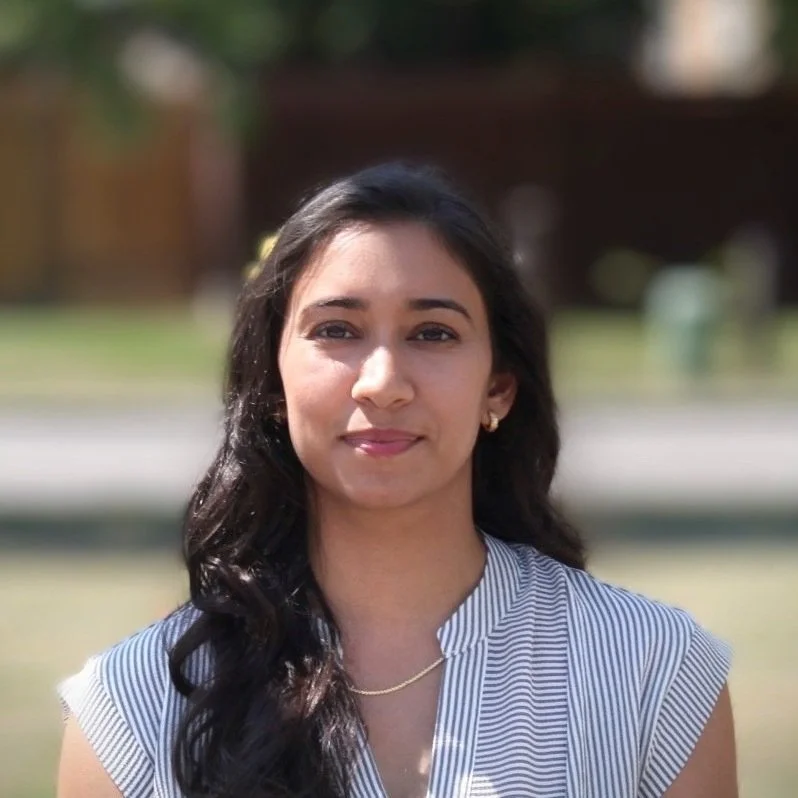
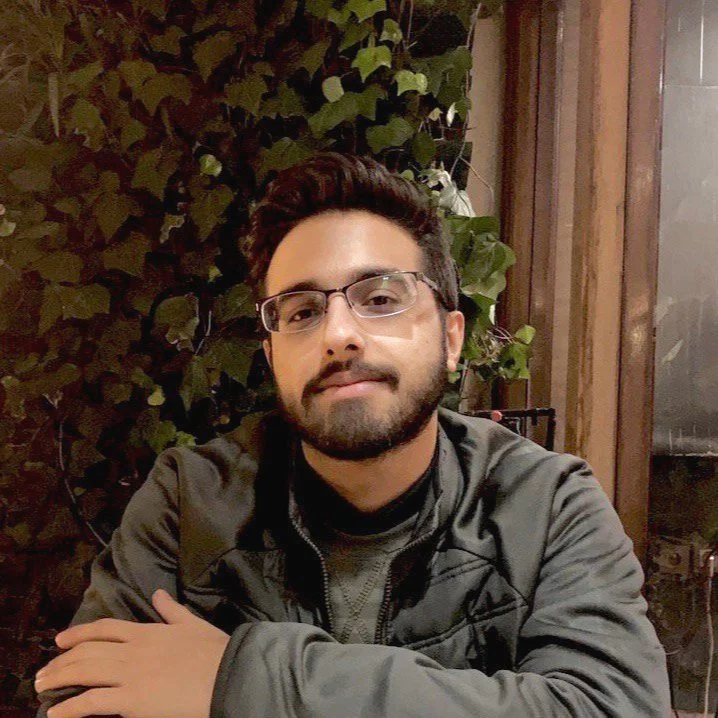
Headshot of Mohammed Merchant 

A dedicated research partner and outspoken patient advocate, Mohammed first joined CHILD-BRIGHT as part of the Phase 1 research project, MATernal hyperoxygenation in Congenital Heart Disease (MATCH), which evaluated whether supplementing mothers with oxygen helps brain development in babies with congenital heart disease (CHD). 

As a parent research partner, Mohammed was instrumental in developing interactive educational materials for the study and creating ways for PWLEs to connect and support one another (such as through a support group). His contributions showcase how having PWLEs on a research team can positively impact the study approach.  

Mohammed’s feedback also supported the research team in the development of its Phase 2 study, Care Pathways for the Developmental Follow-up of Children with CHD. 

Mohammed stands out as a leader in patient-oriented research forums, regularly speaking at conferences and engaging with patient support groups. His passion for improving health care outcomes is evident in his work, and we are pleased to be able to recognize his contributions in this way. 


Youth research partner recipient: Claire Dawe-McCord 

Claire’s patient-oriented research journey began at age 13, when she took part in the CHEO Youth Forum. She became a champion for youth engagement in health care research and went on to co-chair the development of Kids Come First, Ontario's only pediatric Ontario Health Team. Claire has contributed her perspective to the Ministries of Health and Long-Term Care in Ontario, the CHEO Research Institute’s Patient and Family Advisory Committee, and CanChild. 

As a youth research partner with CHILD-BRIGHT's READYorNot™ Brain-Based Disabilities Project, she helped the team develop and study an e-health app to help youth and families take charge of the transition from pediatric to adult health care. Her undergraduate thesis also explored this transition. 

As a current member of the network’s National Youth Advocacy Council, Claire consults with childhood disability research projects to optimize their youth engagement activities. 

Now a medical student at the Cumming School of Medicine at the University of Calgary, Claire continues to mentor youth who are new to patient-oriented research. We are pleased to recognize her leadership in patient-centered approaches to research and health care delivery. 

Mohammed will receive a registration and travel allowance of up to $800 for a conference of his choice in Canada or the United States.  As the youth recipient, Claire will receive up to $800 to either attend a patient-oriented research training event, or to support a patient-oriented research project of her choice. 


Congratulations, Mohammed and Claire! 
Subscribe to our newsletter to receive quarterly updates from the CHILD-BRIGHT Network.

Announcing the recipients of the 2024 CHILD-BRIGHT Graduate Student Fellowship in POR

Français

CHILD-BRIGHT is delighted to announce the recipients of the 2024 CHILD-BRIGHT Graduate Student Fellowship in Patient-Oriented Research! 

This fellowship is designed to create practical training opportunities for graduate students and postdoctoral fellows engaged in patient-oriented research (POR) relating to brain-based developmental disabilities in children. 

This year, the fellowship is supporting our Phase 2 initiatives, which aim to mobilize and implement our research knowledge. POR is integral to evidence-informed health care and CHILD-BRIGHT is proud to support the POR projects of the following two recipients: 

1. Development of the Gamified Version of the Jooay Mobile Application: Promoting Participating of Children and Youth with Disabilities in Leisure Activities 

Recipient: Ebrahim Mahmoudi Kojidi

Project Summary: Play is essential for every child, but unfortunately, children living with brain-based developmental disabilities face challenges when it comes to finding activities adapted to their realities. The Jooay App is a mobile health tool created to help children and youth with disabilities identify and engage in community-based leisure activities, such as sports, arts, and camps in their neighbourhoods. Currently, Jooay is used by over 5,000 rehab and education professionals, families, and youth across Canada. However, the app could benefit over 850,000 Canadian children living with disabilities and their families. 

Working under the supervision of principal investigator Keiko Shikako, Ebrahim aims to understand what mobile app features, specifically gamification features, can motivate youth with disabilities, their parents, and professionals to use the Jooay app more often. Based on their feedback, he will work to design and implement a gamified version of the Jooay App, expand and evaluate its impact, and test strategies to scale up the use of the app across Canada. 

2. Sustainability Planning with the Child-Bright Network

Recipient: Zeenat Ladak

Project Summary: Long-term planning is essential to ensure the sustainability of national health networks such as CHILD-BRIGHT's. Our Legacy and Sustainability Taskforce (LAST) was established to determine how we can sustain the network’s infrastructure beyond 2026. 

Supervised by Dr. Celia Laur, Zeenat Ladak aims to answer two research questions: (1) What aspects of the network contribute to our legacy and should continue to be supported after 2026, and (2) what strategies should be used to support the sustainability of CHILD-BRIGHT's impact and capacity building efforts? 

By using implementation science tools and working closely with the network’s Engagement Council, LAST, and parent research partner Karena Crumpler, the project team will gather and assess member feedback to inform CHILD-BRIGHT's long-term sustainability plan.

CHILD-BRIGHT members ‘connect the dots’ at CIHR research community engagement event

Français

What kind of innovations can emerge from research conducted in networks? Why would you do child health research as part of a network? What perspectives do different key players bring to research networks – and how do these members benefit from their participation?  

These were some of the questions at play on April 9, 2024, when partners with lived and living experience (PWLEs), community organizations, trainees, and researchers at all career stages convened at a research community engagement event with the Canadian Institutes of Health Research Institute of Human Development, Child and Youth Health (CIHR-IHDCYH) and their Institute Advisory Board (IAB). The IAB meets twice a year in a different location across Canada and reserves time to exchange with local child health researchers.  

 This time around, the Research Institute of the McGill University Health Centre (RI-MUHC) invited the IAB to meet RI-MUHC researchers who are leaders of Canadian child health networks for “Connecting the Dots: Learning from Research Network Innovation”, to share their successes and challenges in doing research as part of a national network. 

Christine Chambers, Scientific Director of CIHR-IHDCYH, highlighted the importance of child health research networks in driving innovation, and the focus on interdisciplinarity and collegial information sharing to increase impact, as major strengths of the RI-MUHC. In her closing remarks, Rhian M Touyz, the Executive Director and Chief Scientific Officer of the Research Institute of the McGill University Health Centre, indicated how proud she was of the RI-MUHC researchers who are successfully leading Canadian child health research networks. 

Founded in 2016 and now in Phase 2 of its evolution, CHILD-BRIGHT was well positioned to help bring these discussions forward in a multi-actor context. “In the past nine years, we’ve come to understand the importance of networks in improving patient-oriented research outcomes,” said Annette Majnemer, CHILD-BRIGHT's Nominated Principal Investigator and Scientific Co-Director “We’ve found the network model allows us to authentically engage with key partners – like children and youth with brain-based developmental disabilities and their families – whose perspectives might not be considered in research otherwise.”  

“Connecting the Dots” brought some of those perspectives to the fore, first with a speed networking event, where PWLEs, trainees, community members, and early career researchers discussed the value they brought to their network and what kind of benefits they saw as a result. 

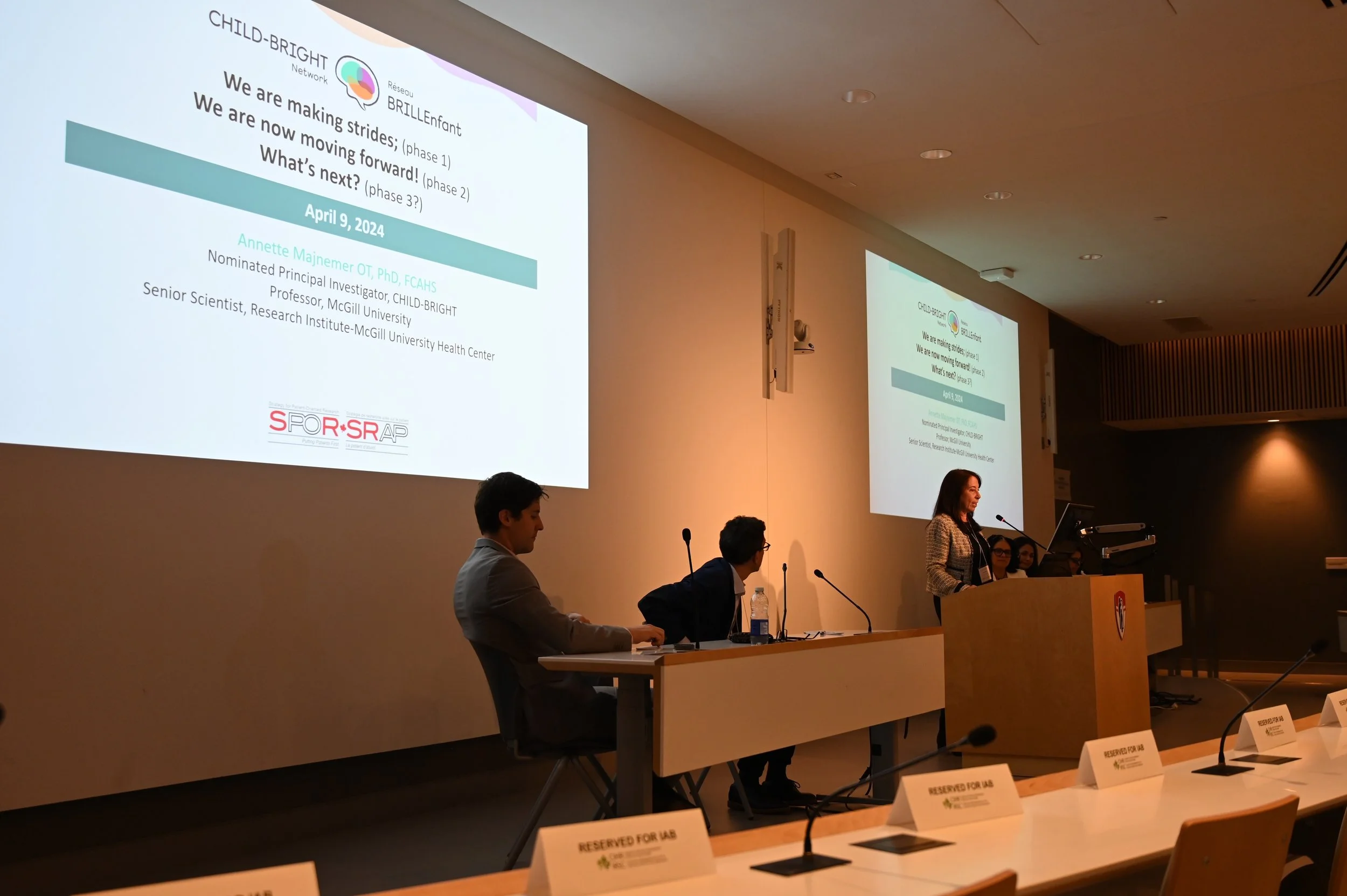
Annette Majnemer participates in a panel discussion featuring child health networks and led by RI-MUHC researchers.

This was followed by a panel discussion featuring child health research networks and led by researchers at the RI-MUHC Child Health and Human Development Program:  

Over 130 people registered to hear these child health network researchers speak to the different stages of network growth as well as key accomplishments and challenges. On behalf of CHILD-BRIGHT, Annette shared some of the strides made in patient-oriented research since the network’s beginnings in 2016. “Our membership now includes 97 PWLEs, and we have developed a wealth of tools and resources to meaningfully engage PWLEs in research,” she said. “It’s exciting to be able to share these learnings with the child health community.” 

One of the key challenges for CHILD-BRIGHT, meanwhile, is ensuring its ongoing sustainability – which is why our Legacy and Sustainability Taskforce is hard at work in developing mechanisms to sustain the gains of our network after Phase 2, Annette shared. 

The RI-MUHC was the ideal host for this gathering, she emphasized: “Not only is it home to the CHILD-BRIGHT Network’s headquarters, but the RI’s dedicated Child Health and Human Development Program brings local researchers together to increase cross-fertilization between disciplines and maximize research impact, all in the service of brighter futures for children and youth across Canada.” 

Thank you to all CHILD-BRIGHT members who helped co-organize and/or took part in this event: Melanie Bergthorson (Jooay project clinician-partner), Roberta Cardoso (KM Program Policy Hub), Mayada Elsabbagh, (KM Program Committee member)  Jessica Hanson (trainee) Ebrahim Mahmoudi (trainee), Annette Majnemer (PI), Steven Miller (PI),  Linda Nguyen,(trainee), Tatiana Ogourtsova (early career researcher), Keiko Shikako (KM Program Co-Lead and Jooay project PI),  and Alix Zerbo (KM Program Information Officer). 

CHILD-BRIGHT is now on LinkedIn! Follow us to stay informed about our latest news and activities.

Announcing CHILD-BRIGHT's language refresh

Français

CHILD-BRIGHT has officially updated the language it uses to better represent the realities of our research partners. In this post, we explain:

  • how we arrived at these changes,  

  • why we deemed them necessary, and 

  • why language matters in health research.

How is CHILD-BRIGHT updating the language it uses?  

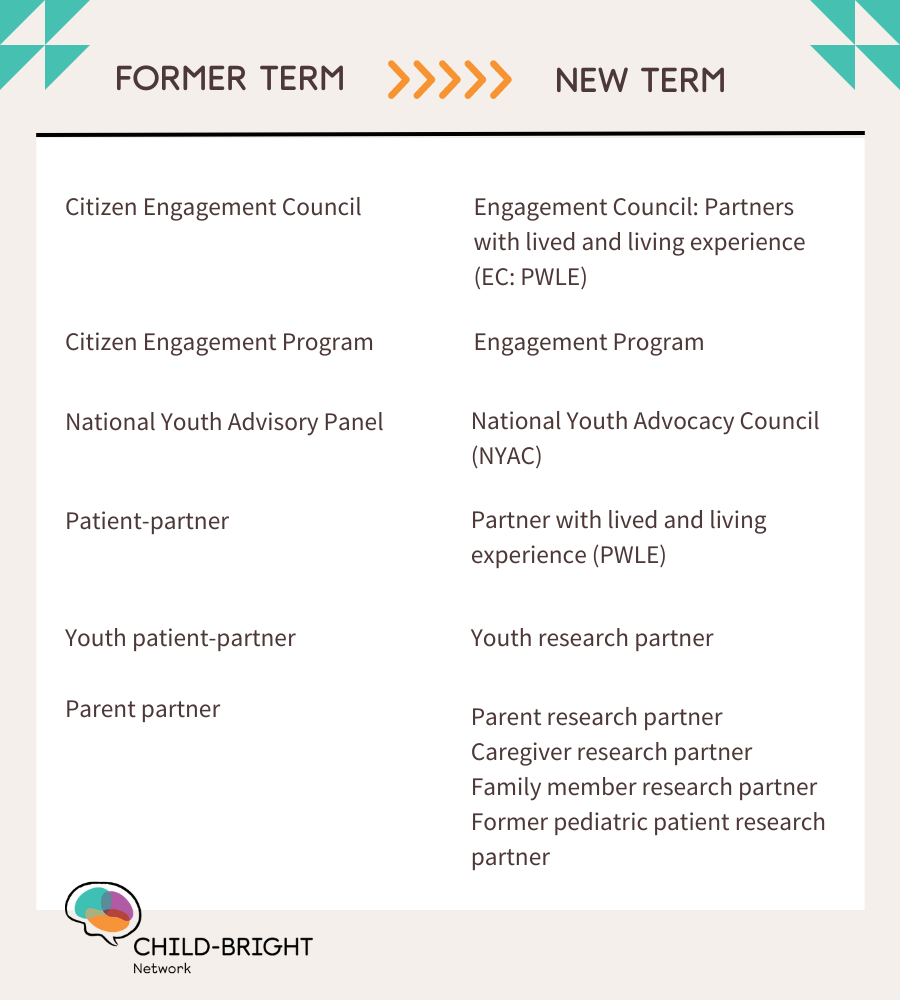
CHILD-BRIGHT has made several updates to the terms it uses to describe engagement and its research partners: 

Download a plain-text version of this table

Why is CHILD-BRIGHT changing the vocabulary it uses to refer to its research partners?

Language has rules, but it is by no means static. The evolution of the vocabulary we use, both within and outside of childhood disability health research, reflects broader cultural shifts in how equity-seeking communities describe themselves, and how we perceive, interact with, and advocate for partners with lived and living experience (PWLEs) within our network. Over the past few months, we have engaged in an extensive consultation process, both with network members and the wider SPOR community, to adopt language that is more accurate, inclusive, and empowering to our youth and family research partners. This language refresh was spearheaded by our former Director of Engagement, Sharon McCarry. 

Sharon McCarry
Former Director of Engagement

“When I joined CHILD-BRIGHT in 2021, one of the main things I wanted to work on was terminology,” says Sharon. Informal discussions around language, especially regarding the term ‘patient’, were ongoing within the network, but in 2023, Sharon saw an opportunity to move forward. CIHR had launched its SPOR Refresh exercise, which aimed to gather input on how to improve Canada's Strategy for Patient-Oriented Research. The year prior, CHILD-BRIGHT had also been successful in its application to the SPOR Networks – Knowledge Mobilization and Implementation Science competition, allowing us to begin moving our patient-oriented research into action through insight and methods grounded in implementation science and knowledge mobilization that embed the principles of equity, diversity, inclusion, decolonization and Indigenization (EDI-DI). 

With change on the horizon, it was an ideal time to discuss the link between language and research partner engagement. Sharon knew that a language refresh would be complex but worthwhile. “When you take the first step, you’re the one everyone’s going to look at,” she says. “You need to have the courage to take the leap.”

How were these terms chosen? 

Network members met at the 2023 CHILD-BRIGHT Conference to discuss moving away from certain terms, including ‘patient’ and ‘citizen engagement.’ ‘Patient,’ which has never been used to refer to First Nations, Métis, and Inuit community partners within the network, felt less and less applicable to our other partners with lived and living experience, as did ‘citizen’. In the months that followed, the network began a lengthy research and consultation process. With many diverse groups and key partners within CHILD-BRIGHT, varying perspectives needed to be heard. “I felt strongly that if labels were going to be considered, the very people that would be ‘labelled’ had to be included in that process,” says Sharon. “So, the exercise really became a grassroots effort.”  

Logan Wong
Co-chair, National Youth Advocacy Council

From the start, feedback from CHILD-BRIGHT's youth members was integral. The network’s National Youth Advisory Panel decided on a revised name: the National Youth Advocacy Council (NYAC). NYAC member Sierra Lynne was steadfast about including the word ‘advocacy’ in the name, and his fellow council members agreed. “It represents us more authentically, because that’s what we are – we’re self-advocates,” says Logan Wong, co-chair of the NYAC. “We want to help children and youth with brain-based developmental disabilities have better experiences in the health care system than we did.” 

Moving forward, CHILD-BRIGHT will use these new terms in all official documentation, with the exception of references to our First Nations, Métis and Inuit community partners, unless otherwise requested. We also recognize that there will never be perfect consensus on language, and we will always respect our research partners’ autonomy to use their preferred terms to identify or describe themselves.

Our role as partners is more than sharing our diagnoses.
— Logan Wong, NYAC co-chair

Why does language matter when doing research about childhood disability? 

The NYAC members were in favour of shifting from ‘patient’ to ‘partner with lived and living experience’. “None of us felt like we were patients,” says Logan. “The word always implied that we were connected to research through the medical system, but we aren’t sick, and our role as partners is more than sharing our diagnoses.”  

In addition to these internal consultations, our Youth and Engagement Initiative Coordinator, Heather Muir, reviewed the public-facing language of other POR networks in Canada and abroad, and discussed terminology with SPOR-funded entities. Finally, CHILD-BRIGHT's new terms were reviewed multiple times by our Executive Committee.  

CHILD-BRIGHT is proud to be the one of the first POR networks to make the leap and officially adopt this language. “I think these changes were necessary,” says Logan. “Language affects how we view disability and health in general. It can minimize stigma.” 

Beyond terminology, CHILD-BRIGHT understands that there is more to be done to equitably engage people with lived and living experience as partners in POR. 

“POR is relatively new,” says Sharon. “It’s only about ten years old.” She points out that the network can always do more to improve its inclusive practices. “A lot of education still needs to be done,” she says. “However, it’s very encouraging to see early career researchers leading the way in using inclusive language and practices in an authentic way. It is inspiring and gives me hope for change!” 

Learn more about the Engagement Program

Postdocs in the Spotlight: Marie-Ève

Welcome to our new blog series highlighting the work of our Azrieli CHILD-BRIGHT postdoctoral fellows!

Within the various research projects underway at the CHILD-BRIGHT Network, postdoctoral fellows play a crucial role. This year, thanks to the generous contribution of the Azrieli Foundation, we’re delighted to welcome a new cohort of up-and-coming scientists who are passionate about patient-oriented research (POR) and its incredible potential in the study of pediatric brain-based developmental disabilities. In the next few weeks, we’ll be showcasing each of our postdocs and the pivotal work they’re doing at CHILD-BRIGHT, across Canada. 

CARE PATHWAYS FOR CHD PROJECT

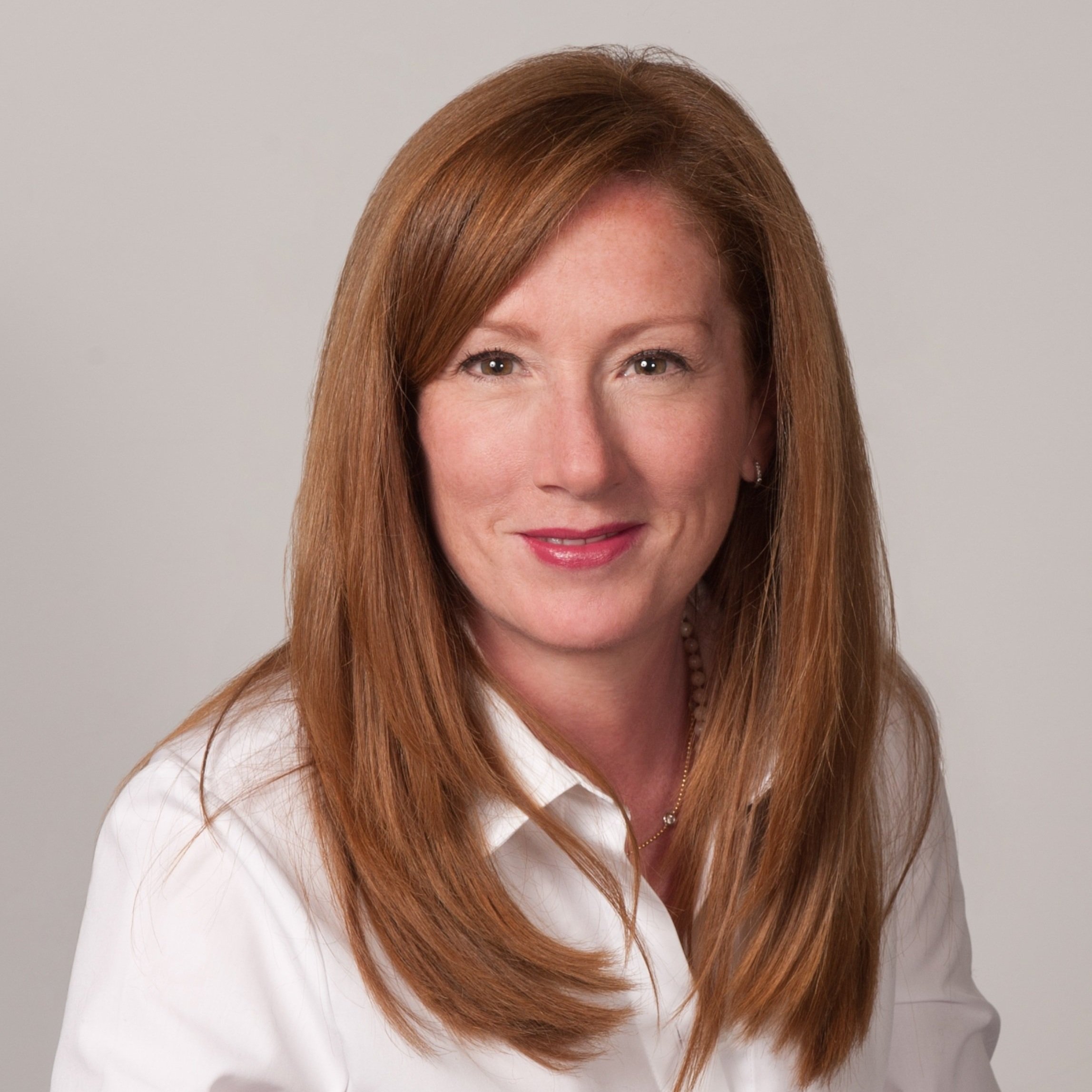
Photo of Marie-Ève Bolduc

Marie-Ève Bolduc (she/her)

Postdoctoral fellow, Centre Hospitalier Universitaire Sainte-Justine 

Assistant professor, School of Physical & Occupational Therapy, McGill University 

Marie-Ève is the postdoctoral fellow on the network’s Care Pathways for CHD project, under the supervision of principal investigators Mike Seed and Andrea Patey. In this Phase 2 CHILD-BRIGHT project, the research team aims to develop recommendations, based on current approaches used around the world, to optimize the identification of developmental delays in children and adolescents with a congenital heart defect (CHD) in Canada. 

Marie-Ève oversees all aspects of coordinating the Care Pathways for CHD project. “My responsibilities include liaising with family partners, conducting comprehensive literature reviews, and leading our consensus groups,” she says. In this multifaceted role, Marie-Ève ensures that all voices are heard, that research is progressing well, and that the project is contributing to the advancement of neurodevelopmental care for children and adolescents with a CHD.

Marie-Ève has been interested in patient-oriented research (POR) since her first collaboration with a parent partner during her PhD. “I realized how important their feedback was,” she recalls. “But later, I realized that the project could’ve benefitted even more from their input.” She wished she’d had a deeper understanding of POR and the strategic integration of partner feedback throughout various project stages. “That’s when I decided to enroll in a patient-oriented research course.”

Marie-Ève believes that incorporating the perspectives of partners with lived experience (PWLE) in research has profound implications for the improvement of outcomes in our health care system. “Patient-generated research questions are instrumental,” she says. “They reflect the unique challenges faced by the individuals we’re trying to help.” While she knows she still has a lot to learn, Marie-Ève is optimistic that her ongoing collaboration with current research partners will help her learn and hone her expertise over time.  

By actively involving users in shaping research agendas, projects become more relevant, resonant, and aligned with the lived experiences of patients. This not only enhances the design of robust research initiatives, but also ensures that patients’ needs and expectations are at the forefront.
— Marie-Ève

Marie-Ève is thrilled to be an Azrieli-CHILD-BRIGHT postdoctoral fellow and knows that the scholarship is an invaluable opportunity to build on the knowledge acquired during her graduate and PhD studies. “Engaging in patient-oriented research and implementation science will not only enhance my skillset, but also significantly elevate the quality of my future projects,” she says happily. Being part of a collaborative network is also allowing her to learn from diverse expertise and make connections with researchers across North America. “This scholarship is a gateway to knowledge exchange, skill refinement, and collaborative opportunities,” says Marie-Ève. “I have no doubt that it will shape the trajectory of my research career.”