
CHILD-BRIGHT Members Share COVID-19 Concerns with Federal Disability Advisory Group Representative

Français

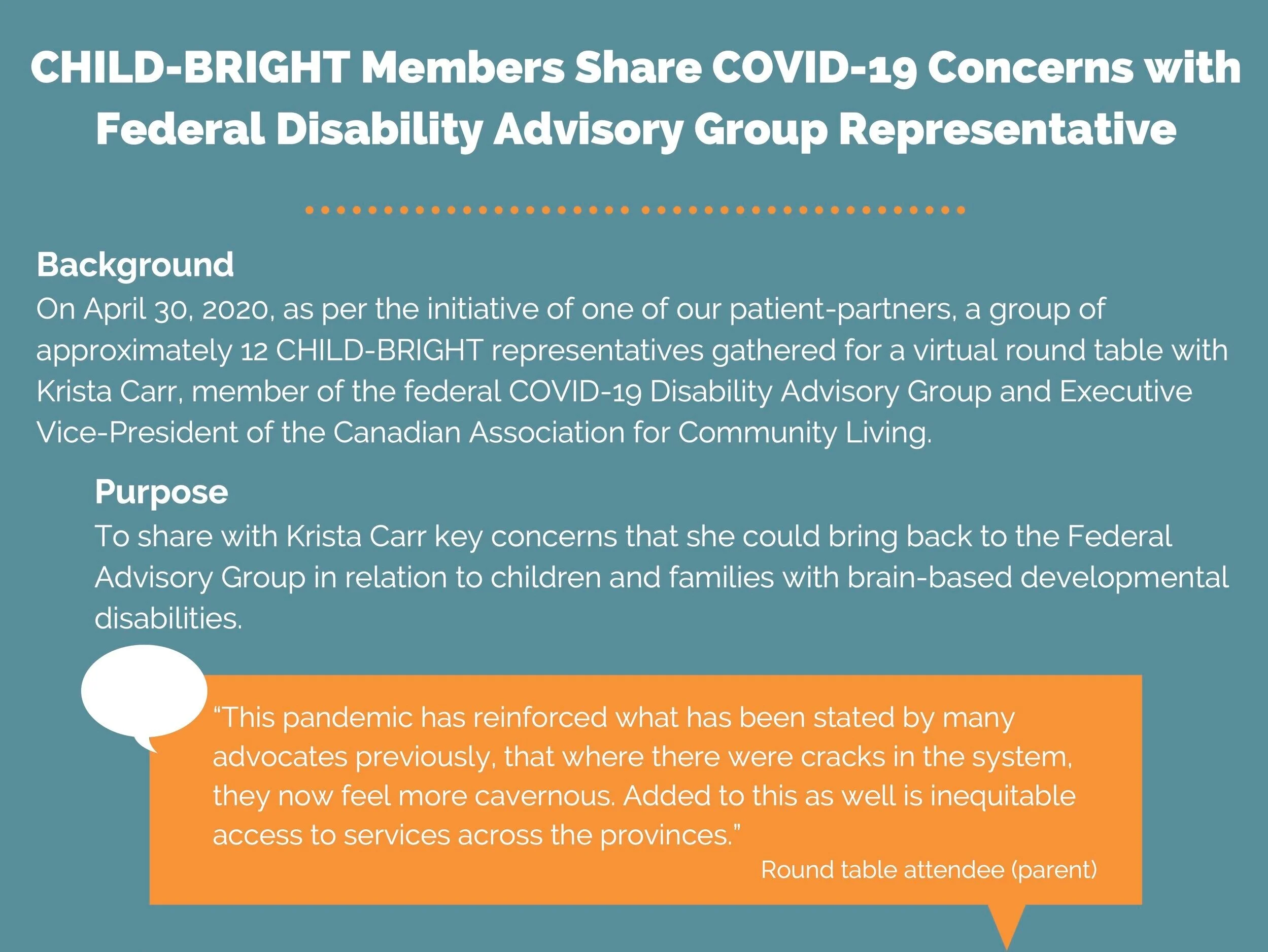
Canadian children with disabilities and their families are facing a great number of challenges during the COVID-19 pandemic. That’s why in May, on the initiative of one of our patient-partners, a group of approximately 12 CHILD-BRIGHT representatives gathered for a virtual round table with Krista Carr, member of the federal COVID-19 Disability Advisory Group and Executive Vice-President of the Canadian Association for Community Living.

Our group, representing various facets of the network, including researchers, patient-partners, and network leaders, exchanged with Krista Carr about concerns and issues that members of our network have brought to our attention, issues that she could bring back to the federal Disability Advisory Group, in relation to children with brain-based disabilities and their families.
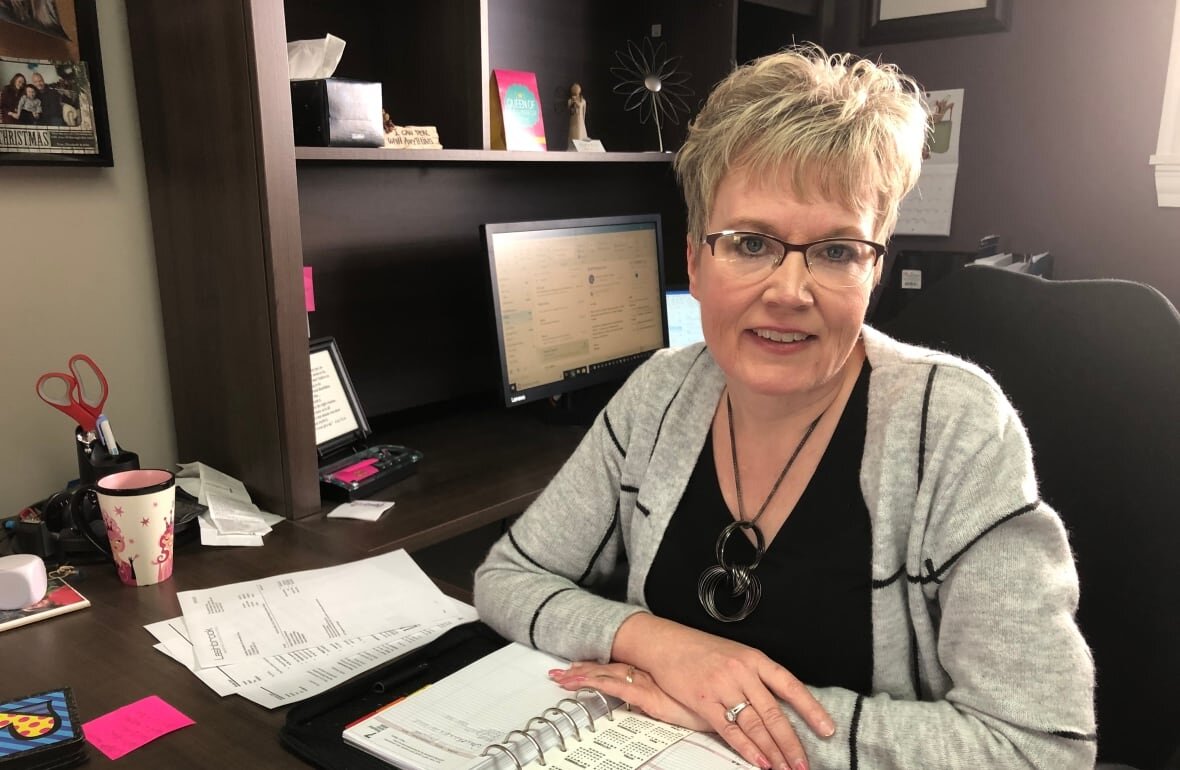
Krista Carr is a member of the federal COVID-19 Disability Advisory Group and Executive Vice-President of the Canadian Association for Community Living.

Krista Carr is a member of the federal COVID-19 Disability Advisory Group and Executive Vice-President of the Canadian Association for Community Living.

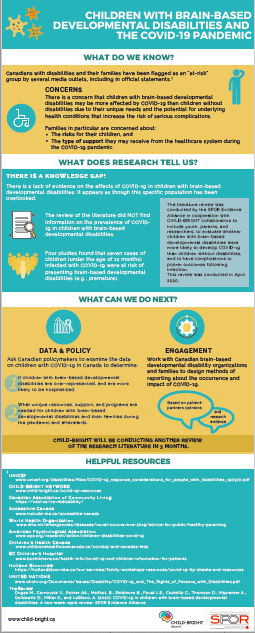
Some of these points presented included the fact that due to the sudden transition to home care occasioned by the pandemic, many parents and caregivers have been cut off from their support networks, including from educators, medical professionals, and respite care providers. This has been challenging for parents.

The inability to access personal protective equipment (PPE)—reserved for front-line workers but not prioritized for caregivers providing medical care at home—was also highlighted as a major concern, alongside unequal access to online care services and to technology for education.

“This pandemic has reinforced what has been stated by many advocates previously, that where there were cracks in the system, they now feel more cavernous. Added to this as well is inequitable access to services across the provinces,” one attendee shared.

With reduced or unequal access to services across provinces, not to mention additional financial burdens on parents who often have to make financial sacrifices to care for their children with disabilities, ensuring that home caregivers are well supported and that the value of their work is recognized was front and center in the round table discussions.

“It would be incredibly helpful to hear that my personal choices and abilities are enough, and they are supported,” expressed a parent-partner.

Because support service workers for children with disabilities are not currently considered ‘essential workers’, the equally important behavioural and psychological needs of children with disabilities are also not being met. One member pointed to an increased dependence on behavioural medications as a result of the pandemic.

With so much uncertainty at present, we shared that a question looming large in the minds of many of our members is: “What’s expected moving forward?” How will the transition to adult services function during this crisis; what will school and education look like in the fall; and how will medical care be impacted? Planning for these events is more complex for families of children with disabilities and more information is needed.

Krista Carr listened attentively and shared that several concerns raised were already topics under review by the federal Advisory Group’s radar. Some were new and would be taken back to the group for consideration. 

CHILD-BRIGHT members in attendance also had the opportunity to share some of the initiatives that we have launched to support children with disabilities and their families during this timeframe.
Head to the MyCOVIDQuestion Twitter page to read the Q&As

Head to the MyCOVIDQuestion Twitter page to read the Q&As

These include our request for support from the SPOR Evidence Alliance to undertake a rapid review evaluating the risk of COVID-19 to children with brain-based developmental disabilities, and our collaboration with CanChild and the Kids Brain Health Network, to launch My COVID Disability Q., a new Twitter Q&A hub geared towards Canadian children and youth with disabilities and their family members.

With the help of our patient-partners, CHILD-BRIGHT also continues to populate a COVID-19 resource page for Canadian youth with disabilities, their families and support teams.

CHILD-BRIGHT Network Director Annette Majnemer was especially appreciative that Krista Carr lent an ear to the group, and stressed the commitment of all in attendance to help the federal government address the concerns raised. “We are a small but close and committed community,” she said. “We will help in any way we can.”

***

UPDATE: We have consolidated the concerns raised in a new infographic. Download it below.
Strongest Families ND wins 2020 ConneKT Funding

Français

We are proud to announce that Strongest Families Neurodevelopmental Program (Strongest Families ND) has been awarded a 2020 CHILD-BRIGHT ConneKT Fund grant, which provides funding of up to $5,000 to CHILD-BRIGHT research teams to help them finance knowledge translation events or products that increase engagement with community partners, achieve meaningful stakeholder participation, and build positive relationships between stakeholders and project members. 

Leads

Parent Advisors will also be invited to contribute.

Funding amount granted:
$4122.75

Project summary:
Children with brain-based developmental disabilities often face emotional and behavioural difficulties. These challenges can negatively impact their quality of life and the quality of life of their families. Our Strongest Families(TM) project explores whether emotional and behavioural regulation can be improved in children with neurodisabilities through parenting programs that include education, telephone support, parent-to-parent connections, and resource information. The ConneKT funds will be used to produce an op-ed with the intent of raising awareness of the challenges faced by many children who have the dual diagnosis of neurodevelopmental disabilities and mental health concerns. The team will also produce two short videos describing the Strongest Families Neurodevelopmental program and study to help inform the public about the work that is being done by the research team.

CONGRATULATIONS!

Are you a CHILD-BRIGHT research project with a knowledge translation idea to increase engagement with community partners? Applications for our ConneKT fund are ongoing! For more information and to apply, contact kt@child-bright.ca.

CHILD-BRIGHT Commissions a Rapid Review to Evaluate the Risk of COVID-19 to Children with Brain-Based Developmental Disabilities

Français

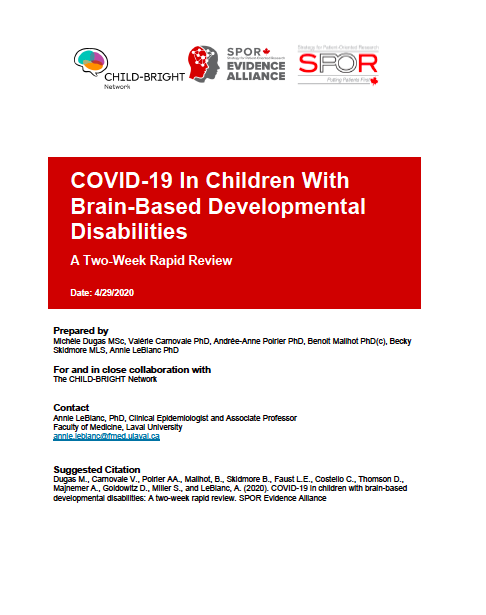
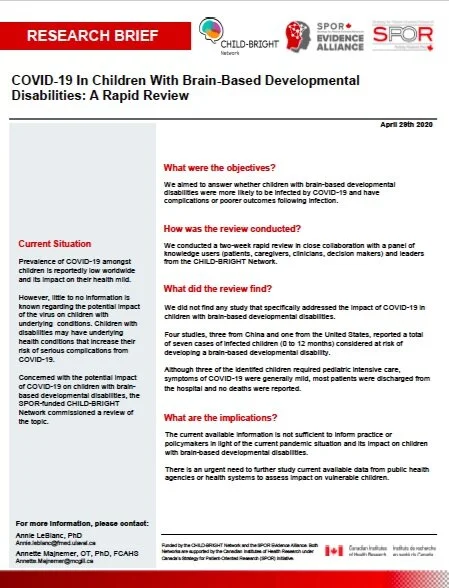
Concerned with the potential impact of the novel coronavirus (COVID-19) on children with brain-based developmental disabilities, our network recently requested support from the SPOR Evidence Alliance to conduct a rapid review to better assess the risk of COVID-19 to children with brain-based developmental disabilities, or those at-risk of developing such diseases.

Our review aimed to answer the following three research questions:

  1. Are children with brain-based developmental disabilities more likely to develop COVID-19?

  2. Are children with brain-based developmental disabilities more likely to develop complications due to COVID-19? And,

  3. Are children with brain-based developmental disabilities more likely to have a poorer prognosis once they develop COVID-19?

Our study highlights a knowledge gap regarding the impact of COVID-19 on children with brain-based disabilities, or those at-risk of developing them. There is an urgent need to gather data regarding this population in order to inform policy makers, decision makers, as well as families.

It appears as though this specific population has been overlooked.

Read more:

We wish to acknowledge and thank the panel of knowledge users from our network who contributed to this study including patient-partners, caregivers, clinicians, decision makers and researchers. They contributed to all steps of the project including developing the questions, doing literature searches, interpreting and drafting the results, and working to disseminating the findings.

Read about other CHILD-BRIGHT COVID-19 Initiatives:
My COVID Disability Q. , an online Q&A hub in partnership with CanChild and Kids Brain Health Network
and
CHILD-BRIGHT COVID-19 list of resources

My COVID Disability Q.: Canada’s New Q&A Hub for Canadians with Disabilities

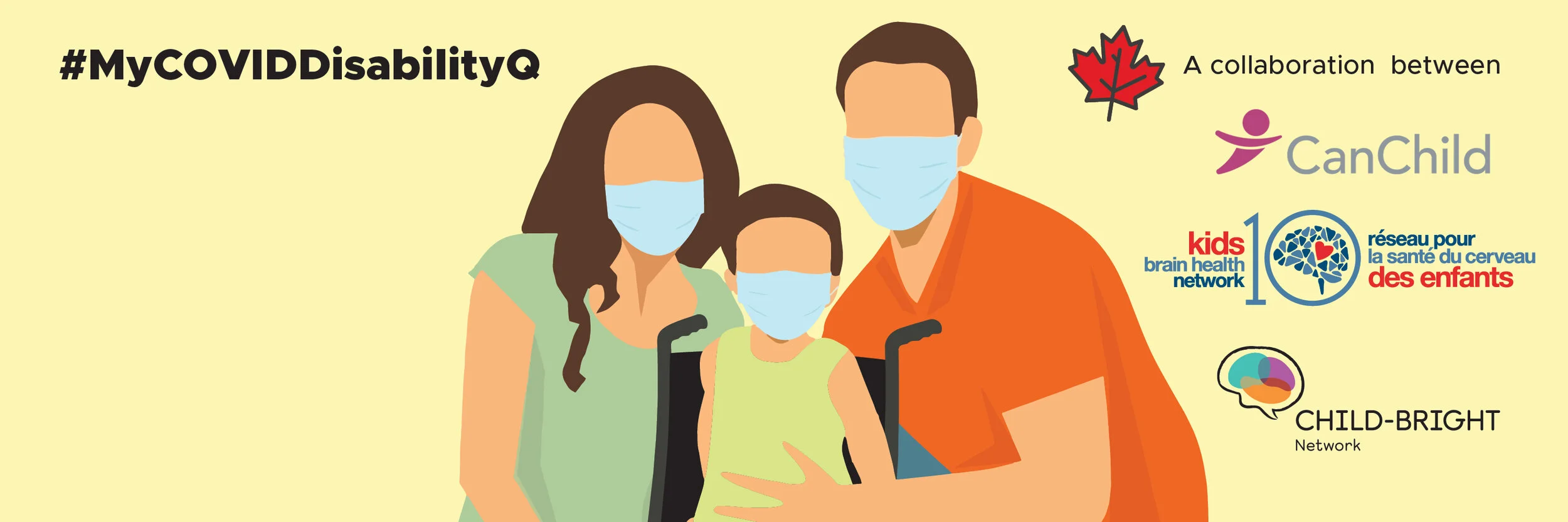
MyCovidDisabilityQ_header_final_2020apr17_hi-res.jpg

CanChild, the Kids Brain Health Network, and the CHILD-BRIGHT Network are happy to announce the launch of My COVID Disability Q., a new Twitter Q&A hub for Canadian children and youth with disabilities as well as family members speaking on their behalf. Using My COVID Disability Q., youth and their family members are invited to ask questions relating to disabilities and the ongoing COVID-19 situation and get credible answers from some of Canada’s leading disability experts working in a wide range of fields including health, research, science, policy, leisure, and wellbeing.

How does it work?
 
It’s easy!

  • First, visit us on Twitter at @MyCOVIDQuestion to see what questions Canadians have asked our disability experts to answer already.

  • Then, submit your own question about COVID-19 using our online form

  • Our moderators at CanChild, the Kids Brain Health Network and the CHILD-BRIGHT Network will post selected questions on Twitter at @MyCOVIDQuestion using the #MyCOVIDDisabilityQ hashtag, brainstorm which experts in our vast networks could help answer, and amplify your question by responding and tagging these Canadian scientific, medical, political, policy or knowledge experts.

  • A conversation around your question will then unfold!

What types of questions can I ask?
 
My COVID Disability Q. is a space for Canadian children and youth with disabilities, as well as family members speaking on their behalf, to ask questions that relate to both their disabilities and the COVID-19 outbreak. For example:

  • You may be wondering if your disability puts you at higher-than-average risk to COVID-19, or

  • You may be looking for recommendations for accessible leisure activities to do from home while your normal activities are suspended, or

  • You may be looking to connect with new youth or caregiver communities remotely, or

  • You may be looking for credible sources of information relating to your disability rights in Canada.

The possibilities are endless! We invite you to submit your question in whatever format is easiest for you (you can type it in, submit a video… you can even include photos!). We’re here to help amplify your questions so you can get answers. Note, however, that we will not provide medical advice.
 
How can the CHILD-BRIGHT Network, CanChild and the Kids Brain Health Network help?
As three of Canada’s leading pediatric networks working to improve outcomes for children with disabilities and their families, CHILD-BRIGHT, the Kids Brain Health Network, and CanChild bring together a vast network of Canadian researchers, clinicians, patient partners, policymakers, and other knowledge experts from the fields of brain-based and developmental disabilities, from across the country. Because we work so closely together around this common goal, we are optimally positioned to amplify your question to the experts within our networks with expertise relevant to your question, including to our contacts within the industry and government. You can read more about each network here:

 
CanChild-150x150.jpg

Founded in 1989, CanChild is a research centre located at McMaster University.  With a large academic network of international scientists, CanChild conducts applied clinical and health services research focused on children and youth with disabilities and their families. As a world-leader in the field, CanChild strives to generate new knowledge and translate research in an accessible way that is relevant and meaningful to those who need it most: children and youth with disabilities and their families. www.canchild.ca

 
KBHN_logo_newspost.jpg

Since 2010, Kids Brain Health Network (KBHN) has been supported by the National Networks of Centres of Excellence (NCE) Program. The NCE is a Canadian government initiative, which funds partnerships between universities, industry, government, and not-for-profit organizations to create large-scale research networks with the overarching goal of delivering socio-economic benefit to Canada. As a research network, KBHN engages and partners with community groups, not-for-profit organizations, industry, parents, clinicians, health professionals, provincial and federal governments, and everyone who can play a role in advancing knowledge to improve outcomes for children with neurodevelopmental disabilities and their families. www.kidsbrainhealth.ca

 
CHILD_BRIGHT_Network_Logo_Coloured_Large_EN.png

The CHILD-BRIGHT Network, headquartered at the Research Institute of the McGill University Health Centre (RI-MUHC), is an innovative pan-Canadian network that aims to improve life outcomes for children with brain-based developmental disabilities and their families. Using family and child-focused approaches, we work to create novel interventions to optimize development, promote health outcomes, and deliver responsive and supportive services. CHILD-BRIGHT is made possible thanks to a five-year grant by the Canadian Institutes of Health Research (CIHR) under Canada’s Strategy for Patient-Oriented Research (SPOR), and 28 generous funding partners from public and private sectors across Canada. www.child-bright.ca

By launching My COVID Disability Q., we strive to help Canadian children and youth with disabilities and family members speaking on their behalf get answers to their questions from credible Canadian sources. Join us and help spread the word.

Submit a question now

Jooay's Guide to Online Resources for Kids with Disabilities: Staying Connected in the Time of Coronavirus

As the repercussions of the Coronavirus outbreak continue to reverberate across Canada, we are all adapting to our different realities as best we can. In many areas, schools and institutions have closed or are operating at reduced capacity, and local, provincial, and federal governments are recommending that people shelter in place whenever possible. 

love-746678_1920.jpg

For families of children with disabilities and complex care needs, staying at home may be more challenging. You may be now administering care that was distributed between the school, rehab centers, and respite care all on your own.  

On a more positive front, you may be noticing that our community is growing stronger and closer. Virtual communities, activities, and connections are taking on growing importance.  

“It is bringing us back to what is important: connection and attention, which is something that our daily lives don’t allow for given all of our overwhelming schedules, therapies, and appointments,” says Joanne Charron-Yannakis. “Instead of doing everything for our kids we can now do everything with our kids, which is just as important—even more important—than academics, therapies, and all other multitude of things we need to do as special needs parents for our children.”

The Jooay App lists adapted and inclusive leisure activities across Canada. All of the Jooay activities are currently not available as we maintain social distance, so the Jooay community wanted to assist virtually to share some resources that can help families, children, and youth to keep participating in leisure activities that are important for them in the new circumstances, and to connect with others to find a community of support in this difficult time.   

Screen Shot 2020-04-01 at 1.03.34 PM.png

Ability Online 
Founded in 1990, Ability Online is a Canadian social media technology platform for young people with disabilities to connect to each other and the world around them. It offers a free, secure, online environment where children and youth can chat, share experiences, and talk about how they are coping.  

JooayLOGO.jpg

Community Connecting to Play 
The Jooay team also maintains the Community Connecting to Play. In this Facebook (private) group (just ask to join if you’re not already in!), the team is gathering and posting activities and ideas of what to do at home, including resources for explaining the coronavirus situation to your children, virtual story time, or even suggestions for a stay-in movie night! We invite you to join the group now to take a look, become part of this community, and share your best strategies and other resources with others. 

We are also happy to share resources from the Canadian Paediatric Society and Children’s Healthcare Canada that include various links to topics that can help at this time, including for children with special health needs. 

If you are at home with your children, we want to know: What are some of your go-to activities to keep your kids occupied? Let us know, so we can stay connected!