
By Sunny Yimeng Dong, CHILD-BRIGHT Multimedia Communications Specialist
Ping! Another email.
Ping! Another virtual meeting.
Ping! Another day.
If you’re in the patient-oriented research (POR) space, chances are your work is virtual. Isn’t it a miracle? Thanks to video calls, virtual whiteboards, and emails, collaborations between researchers and people with lived/living experience (PWLE) can happen virtually every day.
Take CHILD-BRIGHT's National Youth Advocacy Council (NYAC): Our youth partners offer virtual consultations with researchers from across Canada. These consultations have shaped various research and policy projects, including a youth engagement guide for mental health policymaking, and led to a recent partnership with Kids Brain Health Network.
But after five years of being a patient-oriented researcher, PWLE, and multimedia designer in the virtual world, I found myself wondering: How can we deepen the connections we form through screens?
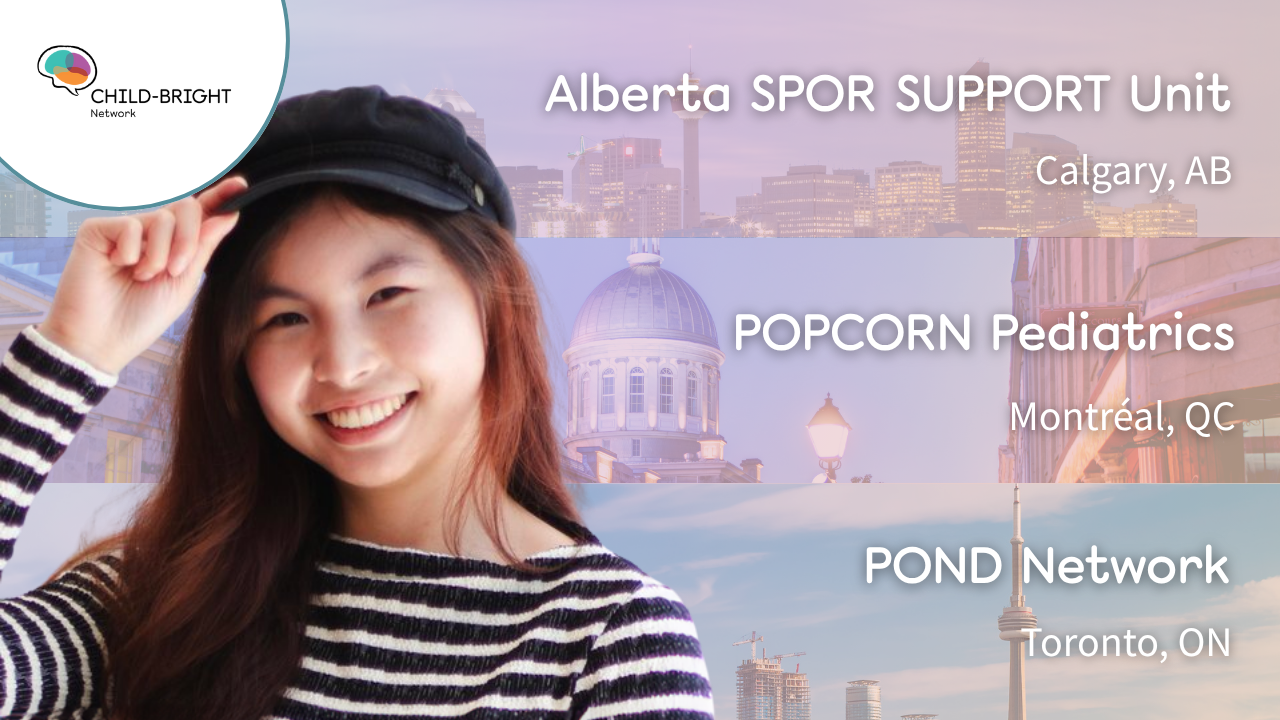
This past spring, I had the opportunity to find out. Three patient-oriented conferences across Canada allowed me to meet many of my virtual collaborators in person for the first time. Each destination offered its own revelations, reminding me why we do this work.
First stop: Calgary, Alberta
In the prairies, I had the chance to listen, ask questions, and connect with fellow CHILD-BRIGHT members. For instance:
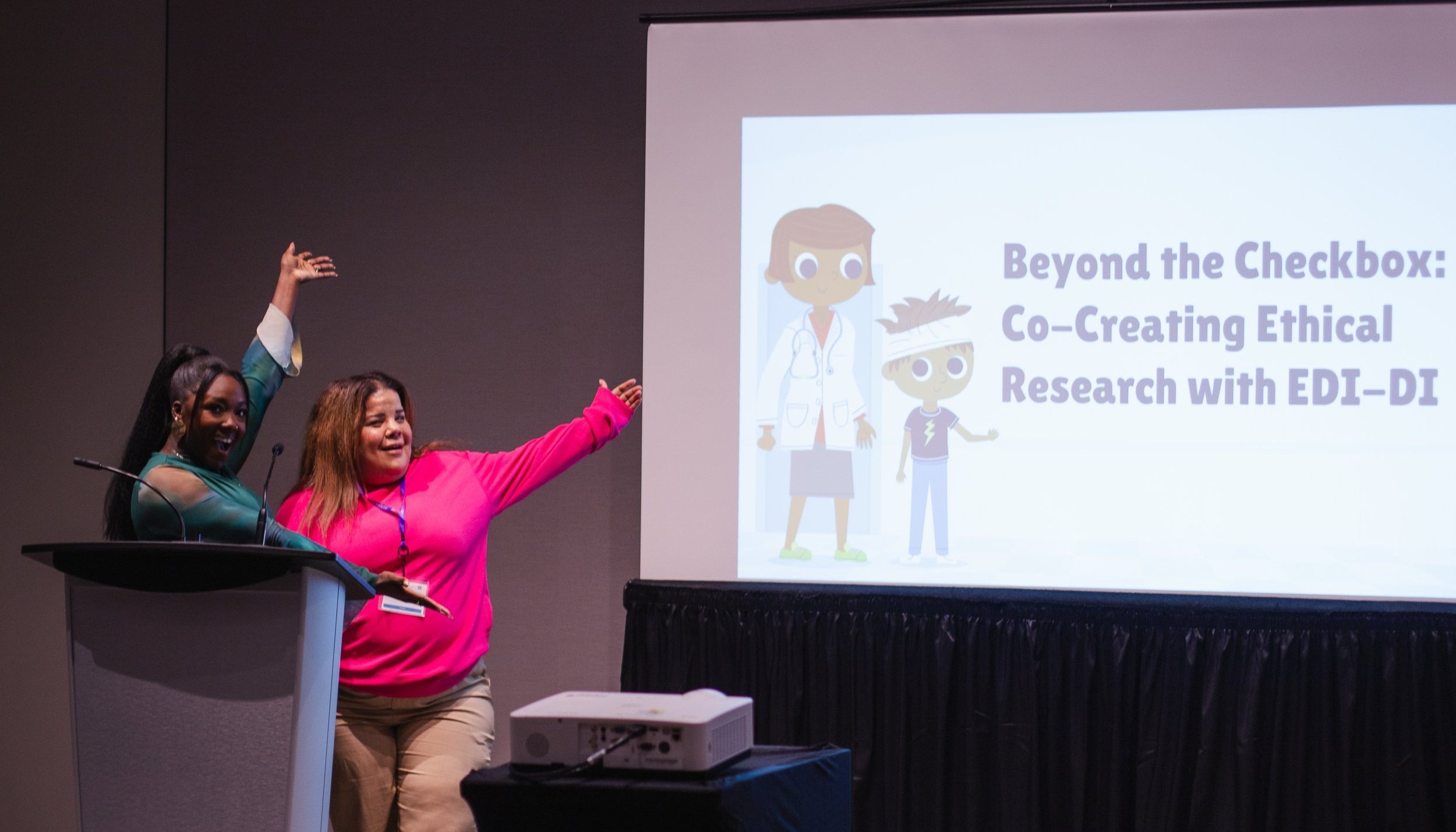
Tinu Akinwande (left) and Samadhi Mora Severino presented on health equity in research design on behalf of CHILD-BRIGHT’s Equity, Diversity, Inclusion, Decolonization, and Indigenization Program.
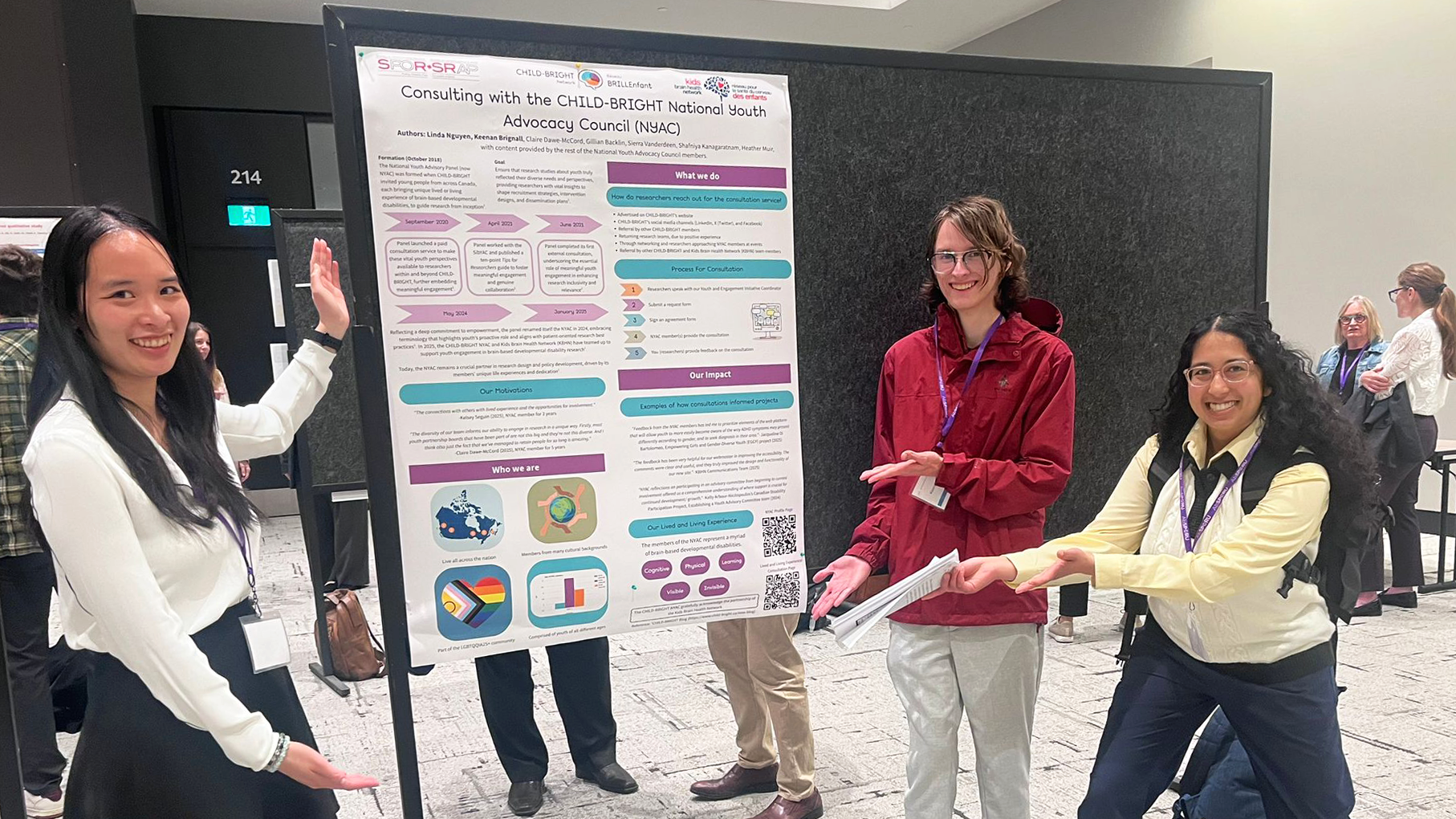
CHILD-BRIGHT researcher Linda Nguyen (below, on left) and two youth research partners – Keenan Brignall (middle) and Shafniya Kanagaratnam – co-presented a poster on consulting with the CHILD-BRIGHT National Youth Advocacy Council (NYAC). It won “Best General Poster”, a testament to a successful collaboration.
After the conference, Brignall reflected:
““It was a fun learning experience… Seeing my work on the wall and talking about it was cool. I’d do it again.” ”
Did you know?
The winning NYAC poster offers a behind-the-scenes look at how youth shape CHILD-BRIGHT projects.
Linda was my co-supervisor for the CHILD-BRIGHT–funded youth engagement in research project from 2021–2023. I truly admire her consistent dedication to POR!
Second stop: Montréal, Quebec
I then flew to Montréal to attend POPCORN's conference on May 22 and 23. Like CHILD-BRIGHT, POPCORN connects researchers and PWLE partners across Canada – but acts as a “network of networks” with a focus on pediatric pandemic preparedness, using COVID-19 as the proof of concept.
The conference was also an opportunity to share insights gleaned from CHILD-BRIGHT’s Phase 1. For example, POPCORN researchers asked if PWLE engagement compensation guidelines existed, which gave me a chance to share CHILD-BRIGHT’s sixth version of the compensation guidelines.
Beyond information exchange, I had the fortunate opportunity to share my story about mental health challenges as a neurodivergent youth, and how contributing to POPCORN’s Indirect Consequences Study was part of my healing. This was delivered as a “live podcast” with the wonderful patient engagement coordinator, Carla Southward. Expressing my lived experience to a room of clinicians and researchers was nerve-wracking, but I’m glad I did it. And it seemed to resonate, too:
“Of all the presenters today, I felt the most connected with you,” an infectious disease pediatrician told me. “Vulnerability brings humanity to the data.”
Did you know?
The Indirect Consequences Study found that as COVID-19 policies became stricter, youth mental health hospitalizations increased across Canada. As a neurodivergent youth, I wonder: how many of those were related to neurodevelopmental conditions?
CHILD-BRIGHT Engagement Council members Suzanne Deliscar and Becky Conia are also members of POPCORN. Small world!
Final stop: Toronto, Ontario
Back in Toronto, I attended POND Network's Family Day on May 31. This community event brought together families navigating autism spectrum disorder (ASD), ADHD, and rare genetic neurodevelopmental conditions to share stories and learn from scientists.

POND youth leader Noah Barnett (left) and I presented a CHILD-BRIGHT–supported Perspectives of Mental Health project, in which nine youth created digital stories about their positive and negative interactions with clinicians when discussing mental health. My role was designing the infographic below and supporting the final stages of a clinician toolkit.
Similar themes surfaced in panel discussions with CHILD-BRIGHT VR-EF Principal Investigator Jennifer Crosbie and family members on mental health, loneliness, and screen time. One message stood out from the group:
““For some neurodivergent youth, connection is the treatment to depression.””
Did you know?
All the families who attended were POND study participants! Among many studies, POND researchers have genome-sequenced thousands of Canadian families, which helped identify 134 autism-related genes. Being in a room full of dedicated families made me emotional and reminded me why engaging them in research is so important.
Marrying virtual collaboration with in-person connection: A winning approach?
Virtual collaboration has made it possible for a pan-Canadian networks like CHILD-BRIGHT, POPCORN and POND to thrive. But there’s something uniquely powerful about sharing space, stories, and moments in person – experiences that can reignite our purpose and strengthen our connections.
From Keenan beaming with joy as he saw his work on display, to POND families bravely opening up about their journeys, every encounter reminded me why patient-oriented research matters and why we must keep pushing the boundaries in brain-based developmental disability research.
If you've felt that spark too, we hope to see you in Toronto on February 2 and 3, 2026, when the CHILD-BRIGHT Network gathers again.
Let’s stay connected.